
diff options
| author | mo khan <mo@mokhan.ca> | 2025-07-22 17:35:49 -0600 |
|---|---|---|
| committer | mo khan <mo@mokhan.ca> | 2025-07-22 17:35:49 -0600 |
| commit | 20ef0d92694465ac86b550df139e8366a0a2b4fa (patch) | |
| tree | 3f14589e1ce6eb9306a3af31c3a1f9e1af5ed637 /vendor/github.com/fatih | |
| parent | 44e0d272c040cdc53a98b9f1dc58ae7da67752e6 (diff) | |
feat: connect to spicedb
Diffstat (limited to 'vendor/github.com/fatih')
| -rw-r--r-- | vendor/github.com/fatih/color/LICENSE.md | 20 | ||||
| -rw-r--r-- | vendor/github.com/fatih/color/README.md | 189 | ||||
| -rw-r--r-- | vendor/github.com/fatih/color/color.go | 685 | ||||
| -rw-r--r-- | vendor/github.com/fatih/color/color_windows.go | 19 | ||||
| -rw-r--r-- | vendor/github.com/fatih/color/doc.go | 134 |
5 files changed, 1047 insertions, 0 deletions
diff --git a/vendor/github.com/fatih/color/LICENSE.md b/vendor/github.com/fatih/color/LICENSE.md new file mode 100644 index 0000000..25fdaf6 --- /dev/null +++ b/vendor/github.com/fatih/color/LICENSE.md @@ -0,0 +1,20 @@ +The MIT License (MIT) + +Copyright (c) 2013 Fatih Arslan + +Permission is hereby granted, free of charge, to any person obtaining a copy of +this software and associated documentation files (the "Software"), to deal in +the Software without restriction, including without limitation the rights to +use, copy, modify, merge, publish, distribute, sublicense, and/or sell copies of +the Software, and to permit persons to whom the Software is furnished to do so, +subject to the following conditions: + +The above copyright notice and this permission notice shall be included in all +copies or substantial portions of the Software. + +THE SOFTWARE IS PROVIDED "AS IS", WITHOUT WARRANTY OF ANY KIND, EXPRESS OR +IMPLIED, INCLUDING BUT NOT LIMITED TO THE WARRANTIES OF MERCHANTABILITY, FITNESS +FOR A PARTICULAR PURPOSE AND NONINFRINGEMENT. IN NO EVENT SHALL THE AUTHORS OR +COPYRIGHT HOLDERS BE LIABLE FOR ANY CLAIM, DAMAGES OR OTHER LIABILITY, WHETHER +IN AN ACTION OF CONTRACT, TORT OR OTHERWISE, ARISING FROM, OUT OF OR IN +CONNECTION WITH THE SOFTWARE OR THE USE OR OTHER DEALINGS IN THE SOFTWARE. diff --git a/vendor/github.com/fatih/color/README.md b/vendor/github.com/fatih/color/README.md new file mode 100644 index 0000000..d135bfe --- /dev/null +++ b/vendor/github.com/fatih/color/README.md @@ -0,0 +1,189 @@ +# color [](https://github.com/fatih/color/actions) [](https://pkg.go.dev/github.com/fatih/color) + +Color lets you use colorized outputs in terms of [ANSI Escape +Codes](http://en.wikipedia.org/wiki/ANSI_escape_code#Colors) in Go (Golang). It +has support for Windows too! The API can be used in several ways, pick one that +suits you. + +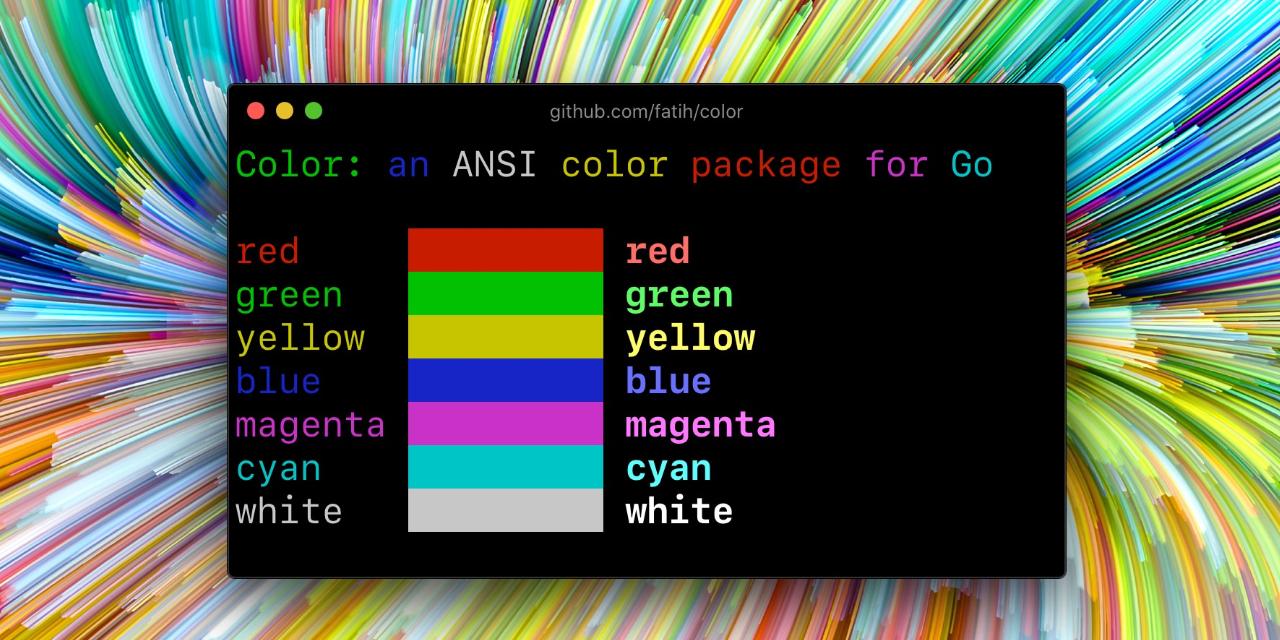 + +## Install + +``` +go get github.com/fatih/color +``` + +## Examples + +### Standard colors + +```go +// Print with default helper functions +color.Cyan("Prints text in cyan.") + +// A newline will be appended automatically +color.Blue("Prints %s in blue.", "text") + +// These are using the default foreground colors +color.Red("We have red") +color.Magenta("And many others ..") + +``` + +### RGB colors + +If your terminal supports 24-bit colors, you can use RGB color codes. + +```go +color.RGB(255, 128, 0).Println("foreground orange") +color.RGB(230, 42, 42).Println("foreground red") + +color.BgRGB(255, 128, 0).Println("background orange") +color.BgRGB(230, 42, 42).Println("background red") +``` + +### Mix and reuse colors + +```go +// Create a new color object +c := color.New(color.FgCyan).Add(color.Underline) +c.Println("Prints cyan text with an underline.") + +// Or just add them to New() +d := color.New(color.FgCyan, color.Bold) +d.Printf("This prints bold cyan %s\n", "too!.") + +// Mix up foreground and background colors, create new mixes! +red := color.New(color.FgRed) + +boldRed := red.Add(color.Bold) +boldRed.Println("This will print text in bold red.") + +whiteBackground := red.Add(color.BgWhite) +whiteBackground.Println("Red text with white background.") + +// Mix with RGB color codes +color.RGB(255, 128, 0).AddBgRGB(0, 0, 0).Println("orange with black background") + +color.BgRGB(255, 128, 0).AddRGB(255, 255, 255).Println("orange background with white foreground") +``` + +### Use your own output (io.Writer) + +```go +// Use your own io.Writer output +color.New(color.FgBlue).Fprintln(myWriter, "blue color!") + +blue := color.New(color.FgBlue) +blue.Fprint(writer, "This will print text in blue.") +``` + +### Custom print functions (PrintFunc) + +```go +// Create a custom print function for convenience +red := color.New(color.FgRed).PrintfFunc() +red("Warning") +red("Error: %s", err) + +// Mix up multiple attributes +notice := color.New(color.Bold, color.FgGreen).PrintlnFunc() +notice("Don't forget this...") +``` + +### Custom fprint functions (FprintFunc) + +```go +blue := color.New(color.FgBlue).FprintfFunc() +blue(myWriter, "important notice: %s", stars) + +// Mix up with multiple attributes +success := color.New(color.Bold, color.FgGreen).FprintlnFunc() +success(myWriter, "Don't forget this...") +``` + +### Insert into noncolor strings (SprintFunc) + +```go +// Create SprintXxx functions to mix strings with other non-colorized strings: +yellow := color.New(color.FgYellow).SprintFunc() +red := color.New(color.FgRed).SprintFunc() +fmt.Printf("This is a %s and this is %s.\n", yellow("warning"), red("error")) + +info := color.New(color.FgWhite, color.BgGreen).SprintFunc() +fmt.Printf("This %s rocks!\n", info("package")) + +// Use helper functions +fmt.Println("This", color.RedString("warning"), "should be not neglected.") +fmt.Printf("%v %v\n", color.GreenString("Info:"), "an important message.") + +// Windows supported too! Just don't forget to change the output to color.Output +fmt.Fprintf(color.Output, "Windows support: %s", color.GreenString("PASS")) +``` + +### Plug into existing code + +```go +// Use handy standard colors +color.Set(color.FgYellow) + +fmt.Println("Existing text will now be in yellow") +fmt.Printf("This one %s\n", "too") + +color.Unset() // Don't forget to unset + +// You can mix up parameters +color.Set(color.FgMagenta, color.Bold) +defer color.Unset() // Use it in your function + +fmt.Println("All text will now be bold magenta.") +``` + +### Disable/Enable color + +There might be a case where you want to explicitly disable/enable color output. the +`go-isatty` package will automatically disable color output for non-tty output streams +(for example if the output were piped directly to `less`). + +The `color` package also disables color output if the [`NO_COLOR`](https://no-color.org) environment +variable is set to a non-empty string. + +`Color` has support to disable/enable colors programmatically both globally and +for single color definitions. For example suppose you have a CLI app and a +`-no-color` bool flag. You can easily disable the color output with: + +```go +var flagNoColor = flag.Bool("no-color", false, "Disable color output") + +if *flagNoColor { + color.NoColor = true // disables colorized output +} +``` + +It also has support for single color definitions (local). You can +disable/enable color output on the fly: + +```go +c := color.New(color.FgCyan) +c.Println("Prints cyan text") + +c.DisableColor() +c.Println("This is printed without any color") + +c.EnableColor() +c.Println("This prints again cyan...") +``` + +## GitHub Actions + +To output color in GitHub Actions (or other CI systems that support ANSI colors), make sure to set `color.NoColor = false` so that it bypasses the check for non-tty output streams. + + +## Credits + +* [Fatih Arslan](https://github.com/fatih) +* Windows support via @mattn: [colorable](https://github.com/mattn/go-colorable) + +## License + +The MIT License (MIT) - see [`LICENSE.md`](https://github.com/fatih/color/blob/master/LICENSE.md) for more details diff --git a/vendor/github.com/fatih/color/color.go b/vendor/github.com/fatih/color/color.go new file mode 100644 index 0000000..ee39b40 --- /dev/null +++ b/vendor/github.com/fatih/color/color.go @@ -0,0 +1,685 @@ +package color + +import ( + "fmt" + "io" + "os" + "strconv" + "strings" + "sync" + + "github.com/mattn/go-colorable" + "github.com/mattn/go-isatty" +) + +var ( + // NoColor defines if the output is colorized or not. It's dynamically set to + // false or true based on the stdout's file descriptor referring to a terminal + // or not. It's also set to true if the NO_COLOR environment variable is + // set (regardless of its value). This is a global option and affects all + // colors. For more control over each color block use the methods + // DisableColor() individually. + NoColor = noColorIsSet() || os.Getenv("TERM") == "dumb" || + (!isatty.IsTerminal(os.Stdout.Fd()) && !isatty.IsCygwinTerminal(os.Stdout.Fd())) + + // Output defines the standard output of the print functions. By default, + // os.Stdout is used. + Output = colorable.NewColorableStdout() + + // Error defines a color supporting writer for os.Stderr. + Error = colorable.NewColorableStderr() + + // colorsCache is used to reduce the count of created Color objects and + // allows to reuse already created objects with required Attribute. + colorsCache = make(map[Attribute]*Color) + colorsCacheMu sync.Mutex // protects colorsCache +) + +// noColorIsSet returns true if the environment variable NO_COLOR is set to a non-empty string. +func noColorIsSet() bool { + return os.Getenv("NO_COLOR") != "" +} + +// Color defines a custom color object which is defined by SGR parameters. +type Color struct { + params []Attribute + noColor *bool +} + +// Attribute defines a single SGR Code +type Attribute int + +const escape = "\x1b" + +// Base attributes +const ( + Reset Attribute = iota + Bold + Faint + Italic + Underline + BlinkSlow + BlinkRapid + ReverseVideo + Concealed + CrossedOut +) + +const ( + ResetBold Attribute = iota + 22 + ResetItalic + ResetUnderline + ResetBlinking + _ + ResetReversed + ResetConcealed + ResetCrossedOut +) + +var mapResetAttributes map[Attribute]Attribute = map[Attribute]Attribute{ + Bold: ResetBold, + Faint: ResetBold, + Italic: ResetItalic, + Underline: ResetUnderline, + BlinkSlow: ResetBlinking, + BlinkRapid: ResetBlinking, + ReverseVideo: ResetReversed, + Concealed: ResetConcealed, + CrossedOut: ResetCrossedOut, +} + +// Foreground text colors +const ( + FgBlack Attribute = iota + 30 + FgRed + FgGreen + FgYellow + FgBlue + FgMagenta + FgCyan + FgWhite + + // used internally for 256 and 24-bit coloring + foreground +) + +// Foreground Hi-Intensity text colors +const ( + FgHiBlack Attribute = iota + 90 + FgHiRed + FgHiGreen + FgHiYellow + FgHiBlue + FgHiMagenta + FgHiCyan + FgHiWhite +) + +// Background text colors +const ( + BgBlack Attribute = iota + 40 + BgRed + BgGreen + BgYellow + BgBlue + BgMagenta + BgCyan + BgWhite + + // used internally for 256 and 24-bit coloring + background +) + +// Background Hi-Intensity text colors +const ( + BgHiBlack Attribute = iota + 100 + BgHiRed + BgHiGreen + BgHiYellow + BgHiBlue + BgHiMagenta + BgHiCyan + BgHiWhite +) + +// New returns a newly created color object. +func New(value ...Attribute) *Color { + c := &Color{ + params: make([]Attribute, 0), + } + + if noColorIsSet() { + c.noColor = boolPtr(true) + } + + c.Add(value...) + return c +} + +// RGB returns a new foreground color in 24-bit RGB. +func RGB(r, g, b int) *Color { + return New(foreground, 2, Attribute(r), Attribute(g), Attribute(b)) +} + +// BgRGB returns a new background color in 24-bit RGB. +func BgRGB(r, g, b int) *Color { + return New(background, 2, Attribute(r), Attribute(g), Attribute(b)) +} + +// AddRGB is used to chain foreground RGB SGR parameters. Use as many as parameters to combine +// and create custom color objects. Example: .Add(34, 0, 12).Add(255, 128, 0). +func (c *Color) AddRGB(r, g, b int) *Color { + c.params = append(c.params, foreground, 2, Attribute(r), Attribute(g), Attribute(b)) + return c +} + +// AddRGB is used to chain background RGB SGR parameters. Use as many as parameters to combine +// and create custom color objects. Example: .Add(34, 0, 12).Add(255, 128, 0). +func (c *Color) AddBgRGB(r, g, b int) *Color { + c.params = append(c.params, background, 2, Attribute(r), Attribute(g), Attribute(b)) + return c +} + +// Set sets the given parameters immediately. It will change the color of +// output with the given SGR parameters until color.Unset() is called. +func Set(p ...Attribute) *Color { + c := New(p...) + c.Set() + return c +} + +// Unset resets all escape attributes and clears the output. Usually should +// be called after Set(). +func Unset() { + if NoColor { + return + } + + fmt.Fprintf(Output, "%s[%dm", escape, Reset) +} + +// Set sets the SGR sequence. +func (c *Color) Set() *Color { + if c.isNoColorSet() { + return c + } + + fmt.Fprint(Output, c.format()) + return c +} + +func (c *Color) unset() { + if c.isNoColorSet() { + return + } + + Unset() +} + +// SetWriter is used to set the SGR sequence with the given io.Writer. This is +// a low-level function, and users should use the higher-level functions, such +// as color.Fprint, color.Print, etc. +func (c *Color) SetWriter(w io.Writer) *Color { + if c.isNoColorSet() { + return c + } + + fmt.Fprint(w, c.format()) + return c +} + +// UnsetWriter resets all escape attributes and clears the output with the give +// io.Writer. Usually should be called after SetWriter(). +func (c *Color) UnsetWriter(w io.Writer) { + if c.isNoColorSet() { + return + } + + if NoColor { + return + } + + fmt.Fprintf(w, "%s[%dm", escape, Reset) +} + +// Add is used to chain SGR parameters. Use as many as parameters to combine +// and create custom color objects. Example: Add(color.FgRed, color.Underline). +func (c *Color) Add(value ...Attribute) *Color { + c.params = append(c.params, value...) + return c +} + +// Fprint formats using the default formats for its operands and writes to w. +// Spaces are added between operands when neither is a string. +// It returns the number of bytes written and any write error encountered. +// On Windows, users should wrap w with colorable.NewColorable() if w is of +// type *os.File. +func (c *Color) Fprint(w io.Writer, a ...interface{}) (n int, err error) { + c.SetWriter(w) + defer c.UnsetWriter(w) + + return fmt.Fprint(w, a...) +} + +// Print formats using the default formats for its operands and writes to +// standard output. Spaces are added between operands when neither is a +// string. It returns the number of bytes written and any write error +// encountered. This is the standard fmt.Print() method wrapped with the given +// color. +func (c *Color) Print(a ...interface{}) (n int, err error) { + c.Set() + defer c.unset() + + return fmt.Fprint(Output, a...) +} + +// Fprintf formats according to a format specifier and writes to w. +// It returns the number of bytes written and any write error encountered. +// On Windows, users should wrap w with colorable.NewColorable() if w is of +// type *os.File. +func (c *Color) Fprintf(w io.Writer, format string, a ...interface{}) (n int, err error) { + c.SetWriter(w) + defer c.UnsetWriter(w) + + return fmt.Fprintf(w, format, a...) +} + +// Printf formats according to a format specifier and writes to standard output. +// It returns the number of bytes written and any write error encountered. +// This is the standard fmt.Printf() method wrapped with the given color. +func (c *Color) Printf(format string, a ...interface{}) (n int, err error) { + c.Set() + defer c.unset() + + return fmt.Fprintf(Output, format, a...) +} + +// Fprintln formats using the default formats for its operands and writes to w. +// Spaces are always added between operands and a newline is appended. +// On Windows, users should wrap w with colorable.NewColorable() if w is of +// type *os.File. +func (c *Color) Fprintln(w io.Writer, a ...interface{}) (n int, err error) { + return fmt.Fprintln(w, c.wrap(sprintln(a...))) +} + +// Println formats using the default formats for its operands and writes to +// standard output. Spaces are always added between operands and a newline is +// appended. It returns the number of bytes written and any write error +// encountered. This is the standard fmt.Print() method wrapped with the given +// color. +func (c *Color) Println(a ...interface{}) (n int, err error) { + return fmt.Fprintln(Output, c.wrap(sprintln(a...))) +} + +// Sprint is just like Print, but returns a string instead of printing it. +func (c *Color) Sprint(a ...interface{}) string { + return c.wrap(fmt.Sprint(a...)) +} + +// Sprintln is just like Println, but returns a string instead of printing it. +func (c *Color) Sprintln(a ...interface{}) string { + return c.wrap(sprintln(a...)) + "\n" +} + +// Sprintf is just like Printf, but returns a string instead of printing it. +func (c *Color) Sprintf(format string, a ...interface{}) string { + return c.wrap(fmt.Sprintf(format, a...)) +} + +// FprintFunc returns a new function that prints the passed arguments as +// colorized with color.Fprint(). +func (c *Color) FprintFunc() func(w io.Writer, a ...interface{}) { + return func(w io.Writer, a ...interface{}) { + c.Fprint(w, a...) + } +} + +// PrintFunc returns a new function that prints the passed arguments as +// colorized with color.Print(). +func (c *Color) PrintFunc() func(a ...interface{}) { + return func(a ...interface{}) { + c.Print(a...) + } +} + +// FprintfFunc returns a new function that prints the passed arguments as +// colorized with color.Fprintf(). +func (c *Color) FprintfFunc() func(w io.Writer, format string, a ...interface{}) { + return func(w io.Writer, format string, a ...interface{}) { + c.Fprintf(w, format, a...) + } +} + +// PrintfFunc returns a new function that prints the passed arguments as +// colorized with color.Printf(). +func (c *Color) PrintfFunc() func(format string, a ...interface{}) { + return func(format string, a ...interface{}) { + c.Printf(format, a...) + } +} + +// FprintlnFunc returns a new function that prints the passed arguments as +// colorized with color.Fprintln(). +func (c *Color) FprintlnFunc() func(w io.Writer, a ...interface{}) { + return func(w io.Writer, a ...interface{}) { + c.Fprintln(w, a...) + } +} + +// PrintlnFunc returns a new function that prints the passed arguments as +// colorized with color.Println(). +func (c *Color) PrintlnFunc() func(a ...interface{}) { + return func(a ...interface{}) { + c.Println(a...) + } +} + +// SprintFunc returns a new function that returns colorized strings for the +// given arguments with fmt.Sprint(). Useful to put into or mix into other +// string. Windows users should use this in conjunction with color.Output, example: +// +// put := New(FgYellow).SprintFunc() +// fmt.Fprintf(color.Output, "This is a %s", put("warning")) +func (c *Color) SprintFunc() func(a ...interface{}) string { + return func(a ...interface{}) string { + return c.wrap(fmt.Sprint(a...)) + } +} + +// SprintfFunc returns a new function that returns colorized strings for the +// given arguments with fmt.Sprintf(). Useful to put into or mix into other +// string. Windows users should use this in conjunction with color.Output. +func (c *Color) SprintfFunc() func(format string, a ...interface{}) string { + return func(format string, a ...interface{}) string { + return c.wrap(fmt.Sprintf(format, a...)) + } +} + +// SprintlnFunc returns a new function that returns colorized strings for the +// given arguments with fmt.Sprintln(). Useful to put into or mix into other +// string. Windows users should use this in conjunction with color.Output. +func (c *Color) SprintlnFunc() func(a ...interface{}) string { + return func(a ...interface{}) string { + return c.wrap(sprintln(a...)) + "\n" + } +} + +// sequence returns a formatted SGR sequence to be plugged into a "\x1b[...m" +// an example output might be: "1;36" -> bold cyan +func (c *Color) sequence() string { + format := make([]string, len(c.params)) + for i, v := range c.params { + format[i] = strconv.Itoa(int(v)) + } + + return strings.Join(format, ";") +} + +// wrap wraps the s string with the colors attributes. The string is ready to +// be printed. +func (c *Color) wrap(s string) string { + if c.isNoColorSet() { + return s + } + + return c.format() + s + c.unformat() +} + +func (c *Color) format() string { + return fmt.Sprintf("%s[%sm", escape, c.sequence()) +} + +func (c *Color) unformat() string { + //return fmt.Sprintf("%s[%dm", escape, Reset) + //for each element in sequence let's use the specific reset escape, or the generic one if not found + format := make([]string, len(c.params)) + for i, v := range c.params { + format[i] = strconv.Itoa(int(Reset)) + ra, ok := mapResetAttributes[v] + if ok { + format[i] = strconv.Itoa(int(ra)) + } + } + + return fmt.Sprintf("%s[%sm", escape, strings.Join(format, ";")) +} + +// DisableColor disables the color output. Useful to not change any existing +// code and still being able to output. Can be used for flags like +// "--no-color". To enable back use EnableColor() method. +func (c *Color) DisableColor() { + c.noColor = boolPtr(true) +} + +// EnableColor enables the color output. Use it in conjunction with +// DisableColor(). Otherwise, this method has no side effects. +func (c *Color) EnableColor() { + c.noColor = boolPtr(false) +} + +func (c *Color) isNoColorSet() bool { + // check first if we have user set action + if c.noColor != nil { + return *c.noColor + } + + // if not return the global option, which is disabled by default + return NoColor +} + +// Equals returns a boolean value indicating whether two colors are equal. +func (c *Color) Equals(c2 *Color) bool { + if c == nil && c2 == nil { + return true + } + if c == nil || c2 == nil { + return false + } + if len(c.params) != len(c2.params) { + return false + } + + for _, attr := range c.params { + if !c2.attrExists(attr) { + return false + } + } + + return true +} + +func (c *Color) attrExists(a Attribute) bool { + for _, attr := range c.params { + if attr == a { + return true + } + } + + return false +} + +func boolPtr(v bool) *bool { + return &v +} + +func getCachedColor(p Attribute) *Color { + colorsCacheMu.Lock() + defer colorsCacheMu.Unlock() + + c, ok := colorsCache[p] + if !ok { + c = New(p) + colorsCache[p] = c + } + + return c +} + +func colorPrint(format string, p Attribute, a ...interface{}) { + c := getCachedColor(p) + + if !strings.HasSuffix(format, "\n") { + format += "\n" + } + + if len(a) == 0 { + c.Print(format) + } else { + c.Printf(format, a...) + } +} + +func colorString(format string, p Attribute, a ...interface{}) string { + c := getCachedColor(p) + + if len(a) == 0 { + return c.SprintFunc()(format) + } + + return c.SprintfFunc()(format, a...) +} + +// Black is a convenient helper function to print with black foreground. A +// newline is appended to format by default. +func Black(format string, a ...interface{}) { colorPrint(format, FgBlack, a...) } + +// Red is a convenient helper function to print with red foreground. A +// newline is appended to format by default. +func Red(format string, a ...interface{}) { colorPrint(format, FgRed, a...) } + +// Green is a convenient helper function to print with green foreground. A +// newline is appended to format by default. +func Green(format string, a ...interface{}) { colorPrint(format, FgGreen, a...) } + +// Yellow is a convenient helper function to print with yellow foreground. +// A newline is appended to format by default. +func Yellow(format string, a ...interface{}) { colorPrint(format, FgYellow, a...) } + +// Blue is a convenient helper function to print with blue foreground. A +// newline is appended to format by default. +func Blue(format string, a ...interface{}) { colorPrint(format, FgBlue, a...) } + +// Magenta is a convenient helper function to print with magenta foreground. +// A newline is appended to format by default. +func Magenta(format string, a ...interface{}) { colorPrint(format, FgMagenta, a...) } + +// Cyan is a convenient helper function to print with cyan foreground. A +// newline is appended to format by default. +func Cyan(format string, a ...interface{}) { colorPrint(format, FgCyan, a...) } + +// White is a convenient helper function to print with white foreground. A +// newline is appended to format by default. +func White(format string, a ...interface{}) { colorPrint(format, FgWhite, a...) } + +// BlackString is a convenient helper function to return a string with black +// foreground. +func BlackString(format string, a ...interface{}) string { return colorString(format, FgBlack, a...) } + +// RedString is a convenient helper function to return a string with red +// foreground. +func RedString(format string, a ...interface{}) string { return colorString(format, FgRed, a...) } + +// GreenString is a convenient helper function to return a string with green +// foreground. +func GreenString(format string, a ...interface{}) string { return colorString(format, FgGreen, a...) } + +// YellowString is a convenient helper function to return a string with yellow +// foreground. +func YellowString(format string, a ...interface{}) string { return colorString(format, FgYellow, a...) } + +// BlueString is a convenient helper function to return a string with blue +// foreground. +func BlueString(format string, a ...interface{}) string { return colorString(format, FgBlue, a...) } + +// MagentaString is a convenient helper function to return a string with magenta +// foreground. +func MagentaString(format string, a ...interface{}) string { + return colorString(format, FgMagenta, a...) +} + +// CyanString is a convenient helper function to return a string with cyan +// foreground. +func CyanString(format string, a ...interface{}) string { return colorString(format, FgCyan, a...) } + +// WhiteString is a convenient helper function to return a string with white +// foreground. +func WhiteString(format string, a ...interface{}) string { return colorString(format, FgWhite, a...) } + +// HiBlack is a convenient helper function to print with hi-intensity black foreground. A +// newline is appended to format by default. +func HiBlack(format string, a ...interface{}) { colorPrint(format, FgHiBlack, a...) } + +// HiRed is a convenient helper function to print with hi-intensity red foreground. A +// newline is appended to format by default. +func HiRed(format string, a ...interface{}) { colorPrint(format, FgHiRed, a...) } + +// HiGreen is a convenient helper function to print with hi-intensity green foreground. A +// newline is appended to format by default. +func HiGreen(format string, a ...interface{}) { colorPrint(format, FgHiGreen, a...) } + +// HiYellow is a convenient helper function to print with hi-intensity yellow foreground. +// A newline is appended to format by default. +func HiYellow(format string, a ...interface{}) { colorPrint(format, FgHiYellow, a...) } + +// HiBlue is a convenient helper function to print with hi-intensity blue foreground. A +// newline is appended to format by default. +func HiBlue(format string, a ...interface{}) { colorPrint(format, FgHiBlue, a...) } + +// HiMagenta is a convenient helper function to print with hi-intensity magenta foreground. +// A newline is appended to format by default. +func HiMagenta(format string, a ...interface{}) { colorPrint(format, FgHiMagenta, a...) } + +// HiCyan is a convenient helper function to print with hi-intensity cyan foreground. A +// newline is appended to format by default. +func HiCyan(format string, a ...interface{}) { colorPrint(format, FgHiCyan, a...) } + +// HiWhite is a convenient helper function to print with hi-intensity white foreground. A +// newline is appended to format by default. +func HiWhite(format string, a ...interface{}) { colorPrint(format, FgHiWhite, a...) } + +// HiBlackString is a convenient helper function to return a string with hi-intensity black +// foreground. +func HiBlackString(format string, a ...interface{}) string { + return colorString(format, FgHiBlack, a...) +} + +// HiRedString is a convenient helper function to return a string with hi-intensity red +// foreground. +func HiRedString(format string, a ...interface{}) string { return colorString(format, FgHiRed, a...) } + +// HiGreenString is a convenient helper function to return a string with hi-intensity green +// foreground. +func HiGreenString(format string, a ...interface{}) string { + return colorString(format, FgHiGreen, a...) +} + +// HiYellowString is a convenient helper function to return a string with hi-intensity yellow +// foreground. +func HiYellowString(format string, a ...interface{}) string { + return colorString(format, FgHiYellow, a...) +} + +// HiBlueString is a convenient helper function to return a string with hi-intensity blue +// foreground. +func HiBlueString(format string, a ...interface{}) string { return colorString(format, FgHiBlue, a...) } + +// HiMagentaString is a convenient helper function to return a string with hi-intensity magenta +// foreground. +func HiMagentaString(format string, a ...interface{}) string { + return colorString(format, FgHiMagenta, a...) +} + +// HiCyanString is a convenient helper function to return a string with hi-intensity cyan +// foreground. +func HiCyanString(format string, a ...interface{}) string { return colorString(format, FgHiCyan, a...) } + +// HiWhiteString is a convenient helper function to return a string with hi-intensity white +// foreground. +func HiWhiteString(format string, a ...interface{}) string { + return colorString(format, FgHiWhite, a...) +} + +// sprintln is a helper function to format a string with fmt.Sprintln and trim the trailing newline. +func sprintln(a ...interface{}) string { + return strings.TrimSuffix(fmt.Sprintln(a...), "\n") +} diff --git a/vendor/github.com/fatih/color/color_windows.go b/vendor/github.com/fatih/color/color_windows.go new file mode 100644 index 0000000..be01c55 --- /dev/null +++ b/vendor/github.com/fatih/color/color_windows.go @@ -0,0 +1,19 @@ +package color + +import ( + "os" + + "golang.org/x/sys/windows" +) + +func init() { + // Opt-in for ansi color support for current process. + // https://learn.microsoft.com/en-us/windows/console/console-virtual-terminal-sequences#output-sequences + var outMode uint32 + out := windows.Handle(os.Stdout.Fd()) + if err := windows.GetConsoleMode(out, &outMode); err != nil { + return + } + outMode |= windows.ENABLE_PROCESSED_OUTPUT | windows.ENABLE_VIRTUAL_TERMINAL_PROCESSING + _ = windows.SetConsoleMode(out, outMode) +} diff --git a/vendor/github.com/fatih/color/doc.go b/vendor/github.com/fatih/color/doc.go new file mode 100644 index 0000000..9491ad5 --- /dev/null +++ b/vendor/github.com/fatih/color/doc.go @@ -0,0 +1,134 @@ +/* +Package color is an ANSI color package to output colorized or SGR defined +output to the standard output. The API can be used in several way, pick one +that suits you. + +Use simple and default helper functions with predefined foreground colors: + + color.Cyan("Prints text in cyan.") + + // a newline will be appended automatically + color.Blue("Prints %s in blue.", "text") + + // More default foreground colors.. + color.Red("We have red") + color.Yellow("Yellow color too!") + color.Magenta("And many others ..") + + // Hi-intensity colors + color.HiGreen("Bright green color.") + color.HiBlack("Bright black means gray..") + color.HiWhite("Shiny white color!") + +However, there are times when custom color mixes are required. Below are some +examples to create custom color objects and use the print functions of each +separate color object. + + // Create a new color object + c := color.New(color.FgCyan).Add(color.Underline) + c.Println("Prints cyan text with an underline.") + + // Or just add them to New() + d := color.New(color.FgCyan, color.Bold) + d.Printf("This prints bold cyan %s\n", "too!.") + + + // Mix up foreground and background colors, create new mixes! + red := color.New(color.FgRed) + + boldRed := red.Add(color.Bold) + boldRed.Println("This will print text in bold red.") + + whiteBackground := red.Add(color.BgWhite) + whiteBackground.Println("Red text with White background.") + + // Use your own io.Writer output + color.New(color.FgBlue).Fprintln(myWriter, "blue color!") + + blue := color.New(color.FgBlue) + blue.Fprint(myWriter, "This will print text in blue.") + +You can create PrintXxx functions to simplify even more: + + // Create a custom print function for convenient + red := color.New(color.FgRed).PrintfFunc() + red("warning") + red("error: %s", err) + + // Mix up multiple attributes + notice := color.New(color.Bold, color.FgGreen).PrintlnFunc() + notice("don't forget this...") + +You can also FprintXxx functions to pass your own io.Writer: + + blue := color.New(FgBlue).FprintfFunc() + blue(myWriter, "important notice: %s", stars) + + // Mix up with multiple attributes + success := color.New(color.Bold, color.FgGreen).FprintlnFunc() + success(myWriter, don't forget this...") + +Or create SprintXxx functions to mix strings with other non-colorized strings: + + yellow := New(FgYellow).SprintFunc() + red := New(FgRed).SprintFunc() + + fmt.Printf("this is a %s and this is %s.\n", yellow("warning"), red("error")) + + info := New(FgWhite, BgGreen).SprintFunc() + fmt.Printf("this %s rocks!\n", info("package")) + +Windows support is enabled by default. All Print functions work as intended. +However, only for color.SprintXXX functions, user should use fmt.FprintXXX and +set the output to color.Output: + + fmt.Fprintf(color.Output, "Windows support: %s", color.GreenString("PASS")) + + info := New(FgWhite, BgGreen).SprintFunc() + fmt.Fprintf(color.Output, "this %s rocks!\n", info("package")) + +Using with existing code is possible. Just use the Set() method to set the +standard output to the given parameters. That way a rewrite of an existing +code is not required. + + // Use handy standard colors. + color.Set(color.FgYellow) + + fmt.Println("Existing text will be now in Yellow") + fmt.Printf("This one %s\n", "too") + + color.Unset() // don't forget to unset + + // You can mix up parameters + color.Set(color.FgMagenta, color.Bold) + defer color.Unset() // use it in your function + + fmt.Println("All text will be now bold magenta.") + +There might be a case where you want to disable color output (for example to +pipe the standard output of your app to somewhere else). `Color` has support to +disable colors both globally and for single color definition. For example +suppose you have a CLI app and a `--no-color` bool flag. You can easily disable +the color output with: + + var flagNoColor = flag.Bool("no-color", false, "Disable color output") + + if *flagNoColor { + color.NoColor = true // disables colorized output + } + +You can also disable the color by setting the NO_COLOR environment variable to any value. + +It also has support for single color definitions (local). You can +disable/enable color output on the fly: + + c := color.New(color.FgCyan) + c.Println("Prints cyan text") + + c.DisableColor() + c.Println("This is printed without any color") + + c.EnableColor() + c.Println("This prints again cyan...") +*/ +package color |