
diff options
| author | mo khan <mo@mokhan.ca> | 2025-07-02 18:36:06 -0600 |
|---|---|---|
| committer | mo khan <mo@mokhan.ca> | 2025-07-02 18:36:06 -0600 |
| commit | 8cdfa445d6629ffef4cb84967ff7017654045bc2 (patch) | |
| tree | 22f0b0907c024c78d26a731e2e1f5219407d8102 /vendor/petgraph/src/graph_impl/mod.rs | |
| parent | 4351c74c7c5f97156bc94d3a8549b9940ac80e3f (diff) | |
chore: add vendor directory
Diffstat (limited to 'vendor/petgraph/src/graph_impl/mod.rs')
| -rw-r--r-- | vendor/petgraph/src/graph_impl/mod.rs | 2411 |
1 files changed, 2411 insertions, 0 deletions
diff --git a/vendor/petgraph/src/graph_impl/mod.rs b/vendor/petgraph/src/graph_impl/mod.rs new file mode 100644 index 00000000..3a123f72 --- /dev/null +++ b/vendor/petgraph/src/graph_impl/mod.rs @@ -0,0 +1,2411 @@ +use std::cmp; +use std::fmt; +use std::hash::Hash; +use std::iter; +use std::marker::PhantomData; +use std::mem::size_of; +use std::ops::{Index, IndexMut, Range}; +use std::slice; + +use fixedbitset::FixedBitSet; + +use crate::{Directed, Direction, EdgeType, Incoming, IntoWeightedEdge, Outgoing, Undirected}; + +use crate::iter_format::{DebugMap, IterFormatExt, NoPretty}; + +use crate::util::enumerate; +use crate::visit; + +#[cfg(feature = "serde-1")] +mod serialization; + +/// The default integer type for graph indices. +/// `u32` is the default to reduce the size of the graph's data and improve +/// performance in the common case. +/// +/// Used for node and edge indices in `Graph` and `StableGraph`, used +/// for node indices in `Csr`. +pub type DefaultIx = u32; + +/// Trait for the unsigned integer type used for node and edge indices. +/// +/// # Safety +/// +/// Marked `unsafe` because: the trait must faithfully preserve +/// and convert index values. +pub unsafe trait IndexType: Copy + Default + Hash + Ord + fmt::Debug + 'static { + fn new(x: usize) -> Self; + fn index(&self) -> usize; + fn max() -> Self; +} + +unsafe impl IndexType for usize { + #[inline(always)] + fn new(x: usize) -> Self { + x + } + #[inline(always)] + fn index(&self) -> Self { + *self + } + #[inline(always)] + fn max() -> Self { + ::std::usize::MAX + } +} + +unsafe impl IndexType for u32 { + #[inline(always)] + fn new(x: usize) -> Self { + x as u32 + } + #[inline(always)] + fn index(&self) -> usize { + *self as usize + } + #[inline(always)] + fn max() -> Self { + ::std::u32::MAX + } +} + +unsafe impl IndexType for u16 { + #[inline(always)] + fn new(x: usize) -> Self { + x as u16 + } + #[inline(always)] + fn index(&self) -> usize { + *self as usize + } + #[inline(always)] + fn max() -> Self { + ::std::u16::MAX + } +} + +unsafe impl IndexType for u8 { + #[inline(always)] + fn new(x: usize) -> Self { + x as u8 + } + #[inline(always)] + fn index(&self) -> usize { + *self as usize + } + #[inline(always)] + fn max() -> Self { + ::std::u8::MAX + } +} + +/// Node identifier. +#[derive(Copy, Clone, Default, PartialEq, PartialOrd, Eq, Ord, Hash)] +pub struct NodeIndex<Ix = DefaultIx>(Ix); + +impl<Ix: IndexType> NodeIndex<Ix> { + #[inline] + pub fn new(x: usize) -> Self { + NodeIndex(IndexType::new(x)) + } + + #[inline] + pub fn index(self) -> usize { + self.0.index() + } + + #[inline] + pub fn end() -> Self { + NodeIndex(IndexType::max()) + } + + fn _into_edge(self) -> EdgeIndex<Ix> { + EdgeIndex(self.0) + } +} + +unsafe impl<Ix: IndexType> IndexType for NodeIndex<Ix> { + fn index(&self) -> usize { + self.0.index() + } + fn new(x: usize) -> Self { + NodeIndex::new(x) + } + fn max() -> Self { + NodeIndex(<Ix as IndexType>::max()) + } +} + +impl<Ix: IndexType> From<Ix> for NodeIndex<Ix> { + fn from(ix: Ix) -> Self { + NodeIndex(ix) + } +} + +impl<Ix: fmt::Debug> fmt::Debug for NodeIndex<Ix> { + fn fmt(&self, f: &mut fmt::Formatter) -> fmt::Result { + write!(f, "NodeIndex({:?})", self.0) + } +} + +/// Short version of `NodeIndex::new` +pub fn node_index<Ix: IndexType>(index: usize) -> NodeIndex<Ix> { + NodeIndex::new(index) +} + +/// Short version of `EdgeIndex::new` +pub fn edge_index<Ix: IndexType>(index: usize) -> EdgeIndex<Ix> { + EdgeIndex::new(index) +} + +/// Edge identifier. +#[derive(Copy, Clone, Default, PartialEq, PartialOrd, Eq, Ord, Hash)] +pub struct EdgeIndex<Ix = DefaultIx>(Ix); + +impl<Ix: IndexType> EdgeIndex<Ix> { + #[inline] + pub fn new(x: usize) -> Self { + EdgeIndex(IndexType::new(x)) + } + + #[inline] + pub fn index(self) -> usize { + self.0.index() + } + + /// An invalid `EdgeIndex` used to denote absence of an edge, for example + /// to end an adjacency list. + #[inline] + pub fn end() -> Self { + EdgeIndex(IndexType::max()) + } + + fn _into_node(self) -> NodeIndex<Ix> { + NodeIndex(self.0) + } +} + +impl<Ix: IndexType> From<Ix> for EdgeIndex<Ix> { + fn from(ix: Ix) -> Self { + EdgeIndex(ix) + } +} + +impl<Ix: fmt::Debug> fmt::Debug for EdgeIndex<Ix> { + fn fmt(&self, f: &mut fmt::Formatter) -> fmt::Result { + write!(f, "EdgeIndex({:?})", self.0) + } +} +/* + * FIXME: Use this impl again, when we don't need to add so many bounds +impl<Ix: IndexType> fmt::Debug for EdgeIndex<Ix> +{ + fn fmt(&self, f: &mut fmt::Formatter) -> fmt::Result { + try!(write!(f, "EdgeIndex(")); + if *self == EdgeIndex::end() { + try!(write!(f, "End")); + } else { + try!(write!(f, "{}", self.index())); + } + write!(f, ")") + } +} +*/ + +const DIRECTIONS: [Direction; 2] = [Outgoing, Incoming]; + +/// The graph's node type. +#[derive(Debug)] +pub struct Node<N, Ix = DefaultIx> { + /// Associated node data. + pub weight: N, + /// Next edge in outgoing and incoming edge lists. + next: [EdgeIndex<Ix>; 2], +} + +impl<E, Ix> Clone for Node<E, Ix> +where + E: Clone, + Ix: Copy, +{ + clone_fields!(Node, weight, next,); +} + +impl<N, Ix: IndexType> Node<N, Ix> { + /// Accessor for data structure internals: the first edge in the given direction. + pub fn next_edge(&self, dir: Direction) -> EdgeIndex<Ix> { + self.next[dir.index()] + } +} + +/// The graph's edge type. +#[derive(Debug)] +pub struct Edge<E, Ix = DefaultIx> { + /// Associated edge data. + pub weight: E, + /// Next edge in outgoing and incoming edge lists. + next: [EdgeIndex<Ix>; 2], + /// Start and End node index + node: [NodeIndex<Ix>; 2], +} + +impl<E, Ix> Clone for Edge<E, Ix> +where + E: Clone, + Ix: Copy, +{ + clone_fields!(Edge, weight, next, node,); +} + +impl<E, Ix: IndexType> Edge<E, Ix> { + /// Accessor for data structure internals: the next edge for the given direction. + pub fn next_edge(&self, dir: Direction) -> EdgeIndex<Ix> { + self.next[dir.index()] + } + + /// Return the source node index. + pub fn source(&self) -> NodeIndex<Ix> { + self.node[0] + } + + /// Return the target node index. + pub fn target(&self) -> NodeIndex<Ix> { + self.node[1] + } +} + +/// `Graph<N, E, Ty, Ix>` is a graph datastructure using an adjacency list representation. +/// +/// `Graph` is parameterized over: +/// +/// - Associated data `N` for nodes and `E` for edges, called *weights*. +/// The associated data can be of arbitrary type. +/// - Edge type `Ty` that determines whether the graph edges are directed or undirected. +/// - Index type `Ix`, which determines the maximum size of the graph. +/// +/// The `Graph` is a regular Rust collection and is `Send` and `Sync` (as long +/// as associated data `N` and `E` are). +/// +/// The graph uses **O(|V| + |E|)** space, and allows fast node and edge insert, +/// efficient graph search and graph algorithms. +/// It implements **O(e')** edge lookup and edge and node removals, where **e'** +/// is some local measure of edge count. +/// Based on the graph datastructure used in rustc. +/// +/// Here's an example of building a graph with directed edges, and below +/// an illustration of how it could be rendered with graphviz (see +/// [`Dot`](../dot/struct.Dot.html)): +/// +/// ``` +/// use petgraph::Graph; +/// +/// let mut deps = Graph::<&str, &str>::new(); +/// let pg = deps.add_node("petgraph"); +/// let fb = deps.add_node("fixedbitset"); +/// let qc = deps.add_node("quickcheck"); +/// let rand = deps.add_node("rand"); +/// let libc = deps.add_node("libc"); +/// deps.extend_with_edges(&[ +/// (pg, fb), (pg, qc), +/// (qc, rand), (rand, libc), (qc, libc), +/// ]); +/// ``` +/// +/// 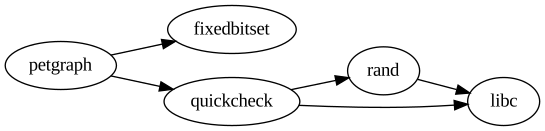 +/// +/// ### Graph Indices +/// +/// The graph maintains indices for nodes and edges, and node and edge +/// weights may be accessed mutably. Indices range in a compact interval, for +/// example for *n* nodes indices are 0 to *n* - 1 inclusive. +/// +/// `NodeIndex` and `EdgeIndex` are types that act as references to nodes and edges, +/// but these are only stable across certain operations: +/// +/// * **Removing nodes or edges may shift other indices.** Removing a node will +/// force the last node to shift its index to take its place. Similarly, +/// removing an edge shifts the index of the last edge. +/// * Adding nodes or edges keeps indices stable. +/// +/// The `Ix` parameter is `u32` by default. The goal is that you can ignore this parameter +/// completely unless you need a very big graph -- then you can use `usize`. +/// +/// * The fact that the node and edge indices in the graph each are numbered in compact +/// intervals (from 0 to *n* - 1 for *n* nodes) simplifies some graph algorithms. +/// +/// * You can select graph index integer type after the size of the graph. A smaller +/// size may have better performance. +/// +/// * Using indices allows mutation while traversing the graph, see `Dfs`, +/// and `.neighbors(a).detach()`. +/// +/// * You can create several graphs using the equal node indices but with +/// differing weights or differing edges. +/// +/// * Indices don't allow as much compile time checking as references. +/// +pub struct Graph<N, E, Ty = Directed, Ix = DefaultIx> { + nodes: Vec<Node<N, Ix>>, + edges: Vec<Edge<E, Ix>>, + ty: PhantomData<Ty>, +} + +/// A `Graph` with directed edges. +/// +/// For example, an edge from *1* to *2* is distinct from an edge from *2* to +/// *1*. +pub type DiGraph<N, E, Ix = DefaultIx> = Graph<N, E, Directed, Ix>; + +/// A `Graph` with undirected edges. +/// +/// For example, an edge between *1* and *2* is equivalent to an edge between +/// *2* and *1*. +pub type UnGraph<N, E, Ix = DefaultIx> = Graph<N, E, Undirected, Ix>; + +/// The resulting cloned graph has the same graph indices as `self`. +impl<N, E, Ty, Ix: IndexType> Clone for Graph<N, E, Ty, Ix> +where + N: Clone, + E: Clone, +{ + fn clone(&self) -> Self { + Graph { + nodes: self.nodes.clone(), + edges: self.edges.clone(), + ty: self.ty, + } + } + + fn clone_from(&mut self, rhs: &Self) { + self.nodes.clone_from(&rhs.nodes); + self.edges.clone_from(&rhs.edges); + self.ty = rhs.ty; + } +} + +impl<N, E, Ty, Ix> fmt::Debug for Graph<N, E, Ty, Ix> +where + N: fmt::Debug, + E: fmt::Debug, + Ty: EdgeType, + Ix: IndexType, +{ + fn fmt(&self, f: &mut fmt::Formatter) -> fmt::Result { + let etype = if self.is_directed() { + "Directed" + } else { + "Undirected" + }; + let mut fmt_struct = f.debug_struct("Graph"); + fmt_struct.field("Ty", &etype); + fmt_struct.field("node_count", &self.node_count()); + fmt_struct.field("edge_count", &self.edge_count()); + if self.edge_count() > 0 { + fmt_struct.field( + "edges", + &self + .edges + .iter() + .map(|e| NoPretty((e.source().index(), e.target().index()))) + .format(", "), + ); + } + // skip weights if they are ZST! + if size_of::<N>() != 0 { + fmt_struct.field( + "node weights", + &DebugMap(|| self.nodes.iter().map(|n| &n.weight).enumerate()), + ); + } + if size_of::<E>() != 0 { + fmt_struct.field( + "edge weights", + &DebugMap(|| self.edges.iter().map(|n| &n.weight).enumerate()), + ); + } + fmt_struct.finish() + } +} + +enum Pair<T> { + Both(T, T), + One(T), + None, +} + +use std::cmp::max; + +/// Get mutable references at index `a` and `b`. +fn index_twice<T>(slc: &mut [T], a: usize, b: usize) -> Pair<&mut T> { + if max(a, b) >= slc.len() { + Pair::None + } else if a == b { + Pair::One(&mut slc[max(a, b)]) + } else { + // safe because a, b are in bounds and distinct + unsafe { + let ptr = slc.as_mut_ptr(); + let ar = &mut *ptr.add(a); + let br = &mut *ptr.add(b); + Pair::Both(ar, br) + } + } +} + +impl<N, E> Graph<N, E, Directed> { + /// Create a new `Graph` with directed edges. + /// + /// This is a convenience method. Use `Graph::with_capacity` or `Graph::default` for + /// a constructor that is generic in all the type parameters of `Graph`. + pub fn new() -> Self { + Graph { + nodes: Vec::new(), + edges: Vec::new(), + ty: PhantomData, + } + } +} + +impl<N, E> Graph<N, E, Undirected> { + /// Create a new `Graph` with undirected edges. + /// + /// This is a convenience method. Use `Graph::with_capacity` or `Graph::default` for + /// a constructor that is generic in all the type parameters of `Graph`. + pub fn new_undirected() -> Self { + Graph { + nodes: Vec::new(), + edges: Vec::new(), + ty: PhantomData, + } + } +} + +impl<N, E, Ty, Ix> Graph<N, E, Ty, Ix> +where + Ty: EdgeType, + Ix: IndexType, +{ + /// Create a new `Graph` with estimated capacity. + pub fn with_capacity(nodes: usize, edges: usize) -> Self { + Graph { + nodes: Vec::with_capacity(nodes), + edges: Vec::with_capacity(edges), + ty: PhantomData, + } + } + + /// Return the number of nodes (vertices) in the graph. + /// + /// Computes in **O(1)** time. + pub fn node_count(&self) -> usize { + self.nodes.len() + } + + /// Return the number of edges in the graph. + /// + /// Computes in **O(1)** time. + pub fn edge_count(&self) -> usize { + self.edges.len() + } + + /// Whether the graph has directed edges or not. + #[inline] + pub fn is_directed(&self) -> bool { + Ty::is_directed() + } + + /// Add a node (also called vertex) with associated data `weight` to the graph. + /// + /// Computes in **O(1)** time. + /// + /// Return the index of the new node. + /// + /// **Panics** if the Graph is at the maximum number of nodes for its index + /// type (N/A if usize). + pub fn add_node(&mut self, weight: N) -> NodeIndex<Ix> { + let node = Node { + weight, + next: [EdgeIndex::end(), EdgeIndex::end()], + }; + let node_idx = NodeIndex::new(self.nodes.len()); + // check for max capacity, except if we use usize + assert!(<Ix as IndexType>::max().index() == !0 || NodeIndex::end() != node_idx); + self.nodes.push(node); + node_idx + } + + /// Access the weight for node `a`. + /// + /// If node `a` doesn't exist in the graph, return `None`. + /// Also available with indexing syntax: `&graph[a]`. + pub fn node_weight(&self, a: NodeIndex<Ix>) -> Option<&N> { + self.nodes.get(a.index()).map(|n| &n.weight) + } + + /// Access the weight for node `a`, mutably. + /// + /// If node `a` doesn't exist in the graph, return `None`. + /// Also available with indexing syntax: `&mut graph[a]`. + pub fn node_weight_mut(&mut self, a: NodeIndex<Ix>) -> Option<&mut N> { + self.nodes.get_mut(a.index()).map(|n| &mut n.weight) + } + + /// Add an edge from `a` to `b` to the graph, with its associated + /// data `weight`. + /// + /// Return the index of the new edge. + /// + /// Computes in **O(1)** time. + /// + /// **Panics** if any of the nodes don't exist.<br> + /// **Panics** if the Graph is at the maximum number of edges for its index + /// type (N/A if usize). + /// + /// **Note:** `Graph` allows adding parallel (“duplicate”) edges. If you want + /// to avoid this, use [`.update_edge(a, b, weight)`](#method.update_edge) instead. + pub fn add_edge(&mut self, a: NodeIndex<Ix>, b: NodeIndex<Ix>, weight: E) -> EdgeIndex<Ix> { + let edge_idx = EdgeIndex::new(self.edges.len()); + assert!(<Ix as IndexType>::max().index() == !0 || EdgeIndex::end() != edge_idx); + let mut edge = Edge { + weight, + node: [a, b], + next: [EdgeIndex::end(); 2], + }; + match index_twice(&mut self.nodes, a.index(), b.index()) { + Pair::None => panic!("Graph::add_edge: node indices out of bounds"), + Pair::One(an) => { + edge.next = an.next; + an.next[0] = edge_idx; + an.next[1] = edge_idx; + } + Pair::Both(an, bn) => { + // a and b are different indices + edge.next = [an.next[0], bn.next[1]]; + an.next[0] = edge_idx; + bn.next[1] = edge_idx; + } + } + self.edges.push(edge); + edge_idx + } + + /// Add or update an edge from `a` to `b`. + /// If the edge already exists, its weight is updated. + /// + /// Return the index of the affected edge. + /// + /// Computes in **O(e')** time, where **e'** is the number of edges + /// connected to `a` (and `b`, if the graph edges are undirected). + /// + /// **Panics** if any of the nodes doesn't exist. + pub fn update_edge(&mut self, a: NodeIndex<Ix>, b: NodeIndex<Ix>, weight: E) -> EdgeIndex<Ix> { + if let Some(ix) = self.find_edge(a, b) { + if let Some(ed) = self.edge_weight_mut(ix) { + *ed = weight; + return ix; + } + } + self.add_edge(a, b, weight) + } + + /// Access the weight for edge `e`. + /// + /// If edge `e` doesn't exist in the graph, return `None`. + /// Also available with indexing syntax: `&graph[e]`. + pub fn edge_weight(&self, e: EdgeIndex<Ix>) -> Option<&E> { + self.edges.get(e.index()).map(|ed| &ed.weight) + } + + /// Access the weight for edge `e`, mutably. + /// + /// If edge `e` doesn't exist in the graph, return `None`. + /// Also available with indexing syntax: `&mut graph[e]`. + pub fn edge_weight_mut(&mut self, e: EdgeIndex<Ix>) -> Option<&mut E> { + self.edges.get_mut(e.index()).map(|ed| &mut ed.weight) + } + + /// Access the source and target nodes for `e`. + /// + /// If edge `e` doesn't exist in the graph, return `None`. + pub fn edge_endpoints(&self, e: EdgeIndex<Ix>) -> Option<(NodeIndex<Ix>, NodeIndex<Ix>)> { + self.edges + .get(e.index()) + .map(|ed| (ed.source(), ed.target())) + } + + /// Remove `a` from the graph if it exists, and return its weight. + /// If it doesn't exist in the graph, return `None`. + /// + /// Apart from `a`, this invalidates the last node index in the graph + /// (that node will adopt the removed node index). Edge indices are + /// invalidated as they would be following the removal of each edge + /// with an endpoint in `a`. + /// + /// Computes in **O(e')** time, where **e'** is the number of affected + /// edges, including *n* calls to `.remove_edge()` where *n* is the number + /// of edges with an endpoint in `a`, and including the edges with an + /// endpoint in the displaced node. + pub fn remove_node(&mut self, a: NodeIndex<Ix>) -> Option<N> { + self.nodes.get(a.index())?; + for d in &DIRECTIONS { + let k = d.index(); + + // Remove all edges from and to this node. + loop { + let next = self.nodes[a.index()].next[k]; + if next == EdgeIndex::end() { + break; + } + let ret = self.remove_edge(next); + debug_assert!(ret.is_some()); + let _ = ret; + } + } + + // Use swap_remove -- only the swapped-in node is going to change + // NodeIndex<Ix>, so we only have to walk its edges and update them. + + let node = self.nodes.swap_remove(a.index()); + + // Find the edge lists of the node that had to relocate. + // It may be that no node had to relocate, then we are done already. + let swap_edges = match self.nodes.get(a.index()) { + None => return Some(node.weight), + Some(ed) => ed.next, + }; + + // The swapped element's old index + let old_index = NodeIndex::new(self.nodes.len()); + let new_index = a; + + // Adjust the starts of the out edges, and ends of the in edges. + for &d in &DIRECTIONS { + let k = d.index(); + let mut edges = edges_walker_mut(&mut self.edges, swap_edges[k], d); + while let Some(curedge) = edges.next_edge() { + debug_assert!(curedge.node[k] == old_index); + curedge.node[k] = new_index; + } + } + Some(node.weight) + } + + /// For edge `e` with endpoints `edge_node`, replace links to it, + /// with links to `edge_next`. + fn change_edge_links( + &mut self, + edge_node: [NodeIndex<Ix>; 2], + e: EdgeIndex<Ix>, + edge_next: [EdgeIndex<Ix>; 2], + ) { + for &d in &DIRECTIONS { + let k = d.index(); + let node = match self.nodes.get_mut(edge_node[k].index()) { + Some(r) => r, + None => { + debug_assert!( + false, + "Edge's endpoint dir={:?} index={:?} not found", + d, edge_node[k] + ); + return; + } + }; + let fst = node.next[k]; + if fst == e { + //println!("Updating first edge 0 for node {}, set to {}", edge_node[0], edge_next[0]); + node.next[k] = edge_next[k]; + } else { + let mut edges = edges_walker_mut(&mut self.edges, fst, d); + while let Some(curedge) = edges.next_edge() { + if curedge.next[k] == e { + curedge.next[k] = edge_next[k]; + break; // the edge can only be present once in the list. + } + } + } + } + } + + /// Remove an edge and return its edge weight, or `None` if it didn't exist. + /// + /// Apart from `e`, this invalidates the last edge index in the graph + /// (that edge will adopt the removed edge index). + /// + /// Computes in **O(e')** time, where **e'** is the size of four particular edge lists, for + /// the vertices of `e` and the vertices of another affected edge. + pub fn remove_edge(&mut self, e: EdgeIndex<Ix>) -> Option<E> { + // every edge is part of two lists, + // outgoing and incoming edges. + // Remove it from both + let (edge_node, edge_next) = match self.edges.get(e.index()) { + None => return None, + Some(x) => (x.node, x.next), + }; + // Remove the edge from its in and out lists by replacing it with + // a link to the next in the list. + self.change_edge_links(edge_node, e, edge_next); + self.remove_edge_adjust_indices(e) + } + + fn remove_edge_adjust_indices(&mut self, e: EdgeIndex<Ix>) -> Option<E> { + // swap_remove the edge -- only the removed edge + // and the edge swapped into place are affected and need updating + // indices. + let edge = self.edges.swap_remove(e.index()); + let swap = match self.edges.get(e.index()) { + // no elment needed to be swapped. + None => return Some(edge.weight), + Some(ed) => ed.node, + }; + let swapped_e = EdgeIndex::new(self.edges.len()); + + // Update the edge lists by replacing links to the old index by references to the new + // edge index. + self.change_edge_links(swap, swapped_e, [e, e]); + Some(edge.weight) + } + + /// Return an iterator of all nodes with an edge starting from `a`. + /// + /// - `Directed`: Outgoing edges from `a`. + /// - `Undirected`: All edges from or to `a`. + /// + /// Produces an empty iterator if the node doesn't exist.<br> + /// Iterator element type is `NodeIndex<Ix>`. + /// + /// Use [`.neighbors(a).detach()`][1] to get a neighbor walker that does + /// not borrow from the graph. + /// + /// [1]: struct.Neighbors.html#method.detach + pub fn neighbors(&self, a: NodeIndex<Ix>) -> Neighbors<E, Ix> { + self.neighbors_directed(a, Outgoing) + } + + /// Return an iterator of all neighbors that have an edge between them and + /// `a`, in the specified direction. + /// If the graph's edges are undirected, this is equivalent to *.neighbors(a)*. + /// + /// - `Directed`, `Outgoing`: All edges from `a`. + /// - `Directed`, `Incoming`: All edges to `a`. + /// - `Undirected`: All edges from or to `a`. + /// + /// Produces an empty iterator if the node doesn't exist.<br> + /// Iterator element type is `NodeIndex<Ix>`. + /// + /// For a `Directed` graph, neighbors are listed in reverse order of their + /// addition to the graph, so the most recently added edge's neighbor is + /// listed first. The order in an `Undirected` graph is arbitrary. + /// + /// Use [`.neighbors_directed(a, dir).detach()`][1] to get a neighbor walker that does + /// not borrow from the graph. + /// + /// [1]: struct.Neighbors.html#method.detach + pub fn neighbors_directed(&self, a: NodeIndex<Ix>, dir: Direction) -> Neighbors<E, Ix> { + let mut iter = self.neighbors_undirected(a); + if self.is_directed() { + let k = dir.index(); + iter.next[1 - k] = EdgeIndex::end(); + iter.skip_start = NodeIndex::end(); + } + iter + } + + /// Return an iterator of all neighbors that have an edge between them and + /// `a`, in either direction. + /// If the graph's edges are undirected, this is equivalent to *.neighbors(a)*. + /// + /// - `Directed` and `Undirected`: All edges from or to `a`. + /// + /// Produces an empty iterator if the node doesn't exist.<br> + /// Iterator element type is `NodeIndex<Ix>`. + /// + /// Use [`.neighbors_undirected(a).detach()`][1] to get a neighbor walker that does + /// not borrow from the graph. + /// + /// [1]: struct.Neighbors.html#method.detach + /// + pub fn neighbors_undirected(&self, a: NodeIndex<Ix>) -> Neighbors<E, Ix> { + Neighbors { + skip_start: a, + edges: &self.edges, + next: match self.nodes.get(a.index()) { + None => [EdgeIndex::end(), EdgeIndex::end()], + Some(n) => n.next, + }, + } + } + + /// Return an iterator of all edges of `a`. + /// + /// - `Directed`: Outgoing edges from `a`. + /// - `Undirected`: All edges connected to `a`. + /// + /// Produces an empty iterator if the node doesn't exist.<br> + /// Iterator element type is `EdgeReference<E, Ix>`. + pub fn edges(&self, a: NodeIndex<Ix>) -> Edges<E, Ty, Ix> { + self.edges_directed(a, Outgoing) + } + + /// Return an iterator of all edges of `a`, in the specified direction. + /// + /// - `Directed`, `Outgoing`: All edges from `a`. + /// - `Directed`, `Incoming`: All edges to `a`. + /// - `Undirected`, `Outgoing`: All edges connected to `a`, with `a` being the source of each + /// edge. + /// - `Undirected`, `Incoming`: All edges connected to `a`, with `a` being the target of each + /// edge. + /// + /// Produces an empty iterator if the node `a` doesn't exist.<br> + /// Iterator element type is `EdgeReference<E, Ix>`. + pub fn edges_directed(&self, a: NodeIndex<Ix>, dir: Direction) -> Edges<E, Ty, Ix> { + Edges { + skip_start: a, + edges: &self.edges, + direction: dir, + next: match self.nodes.get(a.index()) { + None => [EdgeIndex::end(), EdgeIndex::end()], + Some(n) => n.next, + }, + ty: PhantomData, + } + } + + /// Return an iterator over all the edges connecting `a` and `b`. + /// + /// - `Directed`: Outgoing edges from `a`. + /// - `Undirected`: All edges connected to `a`. + /// + /// Iterator element type is `EdgeReference<E, Ix>`. + pub fn edges_connecting( + &self, + a: NodeIndex<Ix>, + b: NodeIndex<Ix>, + ) -> EdgesConnecting<E, Ty, Ix> { + EdgesConnecting { + target_node: b, + edges: self.edges_directed(a, Direction::Outgoing), + ty: PhantomData, + } + } + + /// Lookup if there is an edge from `a` to `b`. + /// + /// Computes in **O(e')** time, where **e'** is the number of edges + /// connected to `a` (and `b`, if the graph edges are undirected). + pub fn contains_edge(&self, a: NodeIndex<Ix>, b: NodeIndex<Ix>) -> bool { + self.find_edge(a, b).is_some() + } + + /// Lookup an edge from `a` to `b`. + /// + /// Computes in **O(e')** time, where **e'** is the number of edges + /// connected to `a` (and `b`, if the graph edges are undirected). + pub fn find_edge(&self, a: NodeIndex<Ix>, b: NodeIndex<Ix>) -> Option<EdgeIndex<Ix>> { + if !self.is_directed() { + self.find_edge_undirected(a, b).map(|(ix, _)| ix) + } else { + match self.nodes.get(a.index()) { + None => None, + Some(node) => self.find_edge_directed_from_node(node, b), + } + } + } + + fn find_edge_directed_from_node( + &self, + node: &Node<N, Ix>, + b: NodeIndex<Ix>, + ) -> Option<EdgeIndex<Ix>> { + let mut edix = node.next[0]; + while let Some(edge) = self.edges.get(edix.index()) { + if edge.node[1] == b { + return Some(edix); + } + edix = edge.next[0]; + } + None + } + + /// Lookup an edge between `a` and `b`, in either direction. + /// + /// If the graph is undirected, then this is equivalent to `.find_edge()`. + /// + /// Return the edge index and its directionality, with `Outgoing` meaning + /// from `a` to `b` and `Incoming` the reverse, + /// or `None` if the edge does not exist. + pub fn find_edge_undirected( + &self, + a: NodeIndex<Ix>, + b: NodeIndex<Ix>, + ) -> Option<(EdgeIndex<Ix>, Direction)> { + match self.nodes.get(a.index()) { + None => None, + Some(node) => self.find_edge_undirected_from_node(node, b), + } + } + + fn find_edge_undirected_from_node( + &self, + node: &Node<N, Ix>, + b: NodeIndex<Ix>, + ) -> Option<(EdgeIndex<Ix>, Direction)> { + for &d in &DIRECTIONS { + let k = d.index(); + let mut edix = node.next[k]; + while let Some(edge) = self.edges.get(edix.index()) { + if edge.node[1 - k] == b { + return Some((edix, d)); + } + edix = edge.next[k]; + } + } + None + } + + /// Return an iterator over either the nodes without edges to them + /// (`Incoming`) or from them (`Outgoing`). + /// + /// An *internal* node has both incoming and outgoing edges. + /// The nodes in `.externals(Incoming)` are the source nodes and + /// `.externals(Outgoing)` are the sinks of the graph. + /// + /// For a graph with undirected edges, both the sinks and the sources are + /// just the nodes without edges. + /// + /// The whole iteration computes in **O(|V|)** time. + pub fn externals(&self, dir: Direction) -> Externals<N, Ty, Ix> { + Externals { + iter: self.nodes.iter().enumerate(), + dir, + ty: PhantomData, + } + } + + /// Return an iterator over the node indices of the graph. + /// + /// For example, in a rare case where a graph algorithm were not applicable, + /// the following code will iterate through all nodes to find a + /// specific index: + /// + /// ``` + /// # use petgraph::Graph; + /// # let mut g = Graph::<&str, i32>::new(); + /// # g.add_node("book"); + /// let index = g.node_indices().find(|i| g[*i] == "book").unwrap(); + /// ``` + pub fn node_indices(&self) -> NodeIndices<Ix> { + NodeIndices { + r: 0..self.node_count(), + ty: PhantomData, + } + } + + /// Return an iterator yielding mutable access to all node weights. + /// + /// The order in which weights are yielded matches the order of their + /// node indices. + pub fn node_weights_mut(&mut self) -> NodeWeightsMut<N, Ix> { + NodeWeightsMut { + nodes: self.nodes.iter_mut(), + } + } + + /// Return an iterator yielding immutable access to all node weights. + /// + /// The order in which weights are yielded matches the order of their + /// node indices. + pub fn node_weights(&self) -> NodeWeights<N, Ix> { + NodeWeights { + nodes: self.nodes.iter(), + } + } + + /// Return an iterator over the edge indices of the graph + pub fn edge_indices(&self) -> EdgeIndices<Ix> { + EdgeIndices { + r: 0..self.edge_count(), + ty: PhantomData, + } + } + + /// Create an iterator over all edges, in indexed order. + /// + /// Iterator element type is `EdgeReference<E, Ix>`. + pub fn edge_references(&self) -> EdgeReferences<E, Ix> { + EdgeReferences { + iter: self.edges.iter().enumerate(), + } + } + + /// Return an iterator yielding immutable access to all edge weights. + /// + /// The order in which weights are yielded matches the order of their + /// edge indices. + pub fn edge_weights(&self) -> EdgeWeights<E, Ix> { + EdgeWeights { + edges: self.edges.iter(), + } + } + /// Return an iterator yielding mutable access to all edge weights. + /// + /// The order in which weights are yielded matches the order of their + /// edge indices. + pub fn edge_weights_mut(&mut self) -> EdgeWeightsMut<E, Ix> { + EdgeWeightsMut { + edges: self.edges.iter_mut(), + } + } + + // Remaining methods are of the more internal flavour, read-only access to + // the data structure's internals. + + /// Access the internal node array. + pub fn raw_nodes(&self) -> &[Node<N, Ix>] { + &self.nodes + } + + /// Access the internal edge array. + pub fn raw_edges(&self) -> &[Edge<E, Ix>] { + &self.edges + } + + #[allow(clippy::type_complexity)] + /// Convert the graph into a vector of Nodes and a vector of Edges + pub fn into_nodes_edges(self) -> (Vec<Node<N, Ix>>, Vec<Edge<E, Ix>>) { + (self.nodes, self.edges) + } + + /// Accessor for data structure internals: the first edge in the given direction. + pub fn first_edge(&self, a: NodeIndex<Ix>, dir: Direction) -> Option<EdgeIndex<Ix>> { + match self.nodes.get(a.index()) { + None => None, + Some(node) => { + let edix = node.next[dir.index()]; + if edix == EdgeIndex::end() { + None + } else { + Some(edix) + } + } + } + } + + /// Accessor for data structure internals: the next edge for the given direction. + pub fn next_edge(&self, e: EdgeIndex<Ix>, dir: Direction) -> Option<EdgeIndex<Ix>> { + match self.edges.get(e.index()) { + None => None, + Some(node) => { + let edix = node.next[dir.index()]; + if edix == EdgeIndex::end() { + None + } else { + Some(edix) + } + } + } + } + + /// Index the `Graph` by two indices, any combination of + /// node or edge indices is fine. + /// + /// **Panics** if the indices are equal or if they are out of bounds. + /// + /// ``` + /// use petgraph::{Graph, Incoming}; + /// use petgraph::visit::Dfs; + /// + /// let mut gr = Graph::new(); + /// let a = gr.add_node(0.); + /// let b = gr.add_node(0.); + /// let c = gr.add_node(0.); + /// gr.add_edge(a, b, 3.); + /// gr.add_edge(b, c, 2.); + /// gr.add_edge(c, b, 1.); + /// + /// // walk the graph and sum incoming edges into the node weight + /// let mut dfs = Dfs::new(&gr, a); + /// while let Some(node) = dfs.next(&gr) { + /// // use a walker -- a detached neighbors iterator + /// let mut edges = gr.neighbors_directed(node, Incoming).detach(); + /// while let Some(edge) = edges.next_edge(&gr) { + /// let (nw, ew) = gr.index_twice_mut(node, edge); + /// *nw += *ew; + /// } + /// } + /// + /// // check the result + /// assert_eq!(gr[a], 0.); + /// assert_eq!(gr[b], 4.); + /// assert_eq!(gr[c], 2.); + /// ``` + pub fn index_twice_mut<T, U>( + &mut self, + i: T, + j: U, + ) -> ( + &mut <Self as Index<T>>::Output, + &mut <Self as Index<U>>::Output, + ) + where + Self: IndexMut<T> + IndexMut<U>, + T: GraphIndex, + U: GraphIndex, + { + assert!(T::is_node_index() != U::is_node_index() || i.index() != j.index()); + + // Allow two mutable indexes here -- they are nonoverlapping + unsafe { + let self_mut = self as *mut _; + ( + <Self as IndexMut<T>>::index_mut(&mut *self_mut, i), + <Self as IndexMut<U>>::index_mut(&mut *self_mut, j), + ) + } + } + + /// Reverse the direction of all edges + pub fn reverse(&mut self) { + // swap edge endpoints, + // edge incoming / outgoing lists, + // node incoming / outgoing lists + for edge in &mut self.edges { + edge.node.swap(0, 1); + edge.next.swap(0, 1); + } + for node in &mut self.nodes { + node.next.swap(0, 1); + } + } + + /// Remove all nodes and edges + pub fn clear(&mut self) { + self.nodes.clear(); + self.edges.clear(); + } + + /// Remove all edges + pub fn clear_edges(&mut self) { + self.edges.clear(); + for node in &mut self.nodes { + node.next = [EdgeIndex::end(), EdgeIndex::end()]; + } + } + + /// Return the current node and edge capacity of the graph. + pub fn capacity(&self) -> (usize, usize) { + (self.nodes.capacity(), self.edges.capacity()) + } + + /// Reserves capacity for at least `additional` more nodes to be inserted in + /// the graph. Graph may reserve more space to avoid frequent reallocations. + /// + /// **Panics** if the new capacity overflows `usize`. + pub fn reserve_nodes(&mut self, additional: usize) { + self.nodes.reserve(additional); + } + + /// Reserves capacity for at least `additional` more edges to be inserted in + /// the graph. Graph may reserve more space to avoid frequent reallocations. + /// + /// **Panics** if the new capacity overflows `usize`. + pub fn reserve_edges(&mut self, additional: usize) { + self.edges.reserve(additional); + } + + /// Reserves the minimum capacity for exactly `additional` more nodes to be + /// inserted in the graph. Does nothing if the capacity is already + /// sufficient. + /// + /// Prefer `reserve_nodes` if future insertions are expected. + /// + /// **Panics** if the new capacity overflows `usize`. + pub fn reserve_exact_nodes(&mut self, additional: usize) { + self.nodes.reserve_exact(additional); + } + + /// Reserves the minimum capacity for exactly `additional` more edges to be + /// inserted in the graph. + /// Does nothing if the capacity is already sufficient. + /// + /// Prefer `reserve_edges` if future insertions are expected. + /// + /// **Panics** if the new capacity overflows `usize`. + pub fn reserve_exact_edges(&mut self, additional: usize) { + self.edges.reserve_exact(additional); + } + + /// Shrinks the capacity of the underlying nodes collection as much as possible. + pub fn shrink_to_fit_nodes(&mut self) { + self.nodes.shrink_to_fit(); + } + + /// Shrinks the capacity of the underlying edges collection as much as possible. + pub fn shrink_to_fit_edges(&mut self) { + self.edges.shrink_to_fit(); + } + + /// Shrinks the capacity of the graph as much as possible. + pub fn shrink_to_fit(&mut self) { + self.nodes.shrink_to_fit(); + self.edges.shrink_to_fit(); + } + + /// Keep all nodes that return `true` from the `visit` closure, + /// remove the others. + /// + /// `visit` is provided a proxy reference to the graph, so that + /// the graph can be walked and associated data modified. + /// + /// The order nodes are visited is not specified. + pub fn retain_nodes<F>(&mut self, mut visit: F) + where + F: FnMut(Frozen<Self>, NodeIndex<Ix>) -> bool, + { + for index in self.node_indices().rev() { + if !visit(Frozen(self), index) { + let ret = self.remove_node(index); + debug_assert!(ret.is_some()); + let _ = ret; + } + } + } + + /// Keep all edges that return `true` from the `visit` closure, + /// remove the others. + /// + /// `visit` is provided a proxy reference to the graph, so that + /// the graph can be walked and associated data modified. + /// + /// The order edges are visited is not specified. + pub fn retain_edges<F>(&mut self, mut visit: F) + where + F: FnMut(Frozen<Self>, EdgeIndex<Ix>) -> bool, + { + for index in self.edge_indices().rev() { + if !visit(Frozen(self), index) { + let ret = self.remove_edge(index); + debug_assert!(ret.is_some()); + let _ = ret; + } + } + } + + /// Create a new `Graph` from an iterable of edges. + /// + /// Node weights `N` are set to default values. + /// Edge weights `E` may either be specified in the list, + /// or they are filled with default values. + /// + /// Nodes are inserted automatically to match the edges. + /// + /// ``` + /// use petgraph::Graph; + /// + /// let gr = Graph::<(), i32>::from_edges(&[ + /// (0, 1), (0, 2), (0, 3), + /// (1, 2), (1, 3), + /// (2, 3), + /// ]); + /// ``` + pub fn from_edges<I>(iterable: I) -> Self + where + I: IntoIterator, + I::Item: IntoWeightedEdge<E>, + <I::Item as IntoWeightedEdge<E>>::NodeId: Into<NodeIndex<Ix>>, + N: Default, + { + let mut g = Self::with_capacity(0, 0); + g.extend_with_edges(iterable); + g + } + + /// Extend the graph from an iterable of edges. + /// + /// Node weights `N` are set to default values. + /// Edge weights `E` may either be specified in the list, + /// or they are filled with default values. + /// + /// Nodes are inserted automatically to match the edges. + pub fn extend_with_edges<I>(&mut self, iterable: I) + where + I: IntoIterator, + I::Item: IntoWeightedEdge<E>, + <I::Item as IntoWeightedEdge<E>>::NodeId: Into<NodeIndex<Ix>>, + N: Default, + { + let iter = iterable.into_iter(); + let (low, _) = iter.size_hint(); + self.edges.reserve(low); + + for elt in iter { + let (source, target, weight) = elt.into_weighted_edge(); + let (source, target) = (source.into(), target.into()); + let nx = cmp::max(source, target); + while nx.index() >= self.node_count() { + self.add_node(N::default()); + } + self.add_edge(source, target, weight); + } + } + + /// Create a new `Graph` by mapping node and + /// edge weights to new values. + /// + /// The resulting graph has the same structure and the same + /// graph indices as `self`. + pub fn map<'a, F, G, N2, E2>( + &'a self, + mut node_map: F, + mut edge_map: G, + ) -> Graph<N2, E2, Ty, Ix> + where + F: FnMut(NodeIndex<Ix>, &'a N) -> N2, + G: FnMut(EdgeIndex<Ix>, &'a E) -> E2, + { + let mut g = Graph::with_capacity(self.node_count(), self.edge_count()); + g.nodes.extend(enumerate(&self.nodes).map(|(i, node)| Node { + weight: node_map(NodeIndex::new(i), &node.weight), + next: node.next, + })); + g.edges.extend(enumerate(&self.edges).map(|(i, edge)| Edge { + weight: edge_map(EdgeIndex::new(i), &edge.weight), + next: edge.next, + node: edge.node, + })); + g + } + + /// Create a new `Graph` by mapping nodes and edges. + /// A node or edge may be mapped to `None` to exclude it from + /// the resulting graph. + /// + /// Nodes are mapped first with the `node_map` closure, then + /// `edge_map` is called for the edges that have not had any endpoint + /// removed. + /// + /// The resulting graph has the structure of a subgraph of the original graph. + /// If no nodes are removed, the resulting graph has compatible node + /// indices; if neither nodes nor edges are removed, the result has + /// the same graph indices as `self`. + pub fn filter_map<'a, F, G, N2, E2>( + &'a self, + mut node_map: F, + mut edge_map: G, + ) -> Graph<N2, E2, Ty, Ix> + where + F: FnMut(NodeIndex<Ix>, &'a N) -> Option<N2>, + G: FnMut(EdgeIndex<Ix>, &'a E) -> Option<E2>, + { + let mut g = Graph::with_capacity(0, 0); + // mapping from old node index to new node index, end represents removed. + let mut node_index_map = vec![NodeIndex::end(); self.node_count()]; + for (i, node) in enumerate(&self.nodes) { + if let Some(nw) = node_map(NodeIndex::new(i), &node.weight) { + node_index_map[i] = g.add_node(nw); + } + } + for (i, edge) in enumerate(&self.edges) { + // skip edge if any endpoint was removed + let source = node_index_map[edge.source().index()]; + let target = node_index_map[edge.target().index()]; + if source != NodeIndex::end() && target != NodeIndex::end() { + if let Some(ew) = edge_map(EdgeIndex::new(i), &edge.weight) { + g.add_edge(source, target, ew); + } + } + } + g + } + + /// Convert the graph into either undirected or directed. No edge adjustments + /// are done, so you may want to go over the result to remove or add edges. + /// + /// Computes in **O(1)** time. + pub fn into_edge_type<NewTy>(self) -> Graph<N, E, NewTy, Ix> + where + NewTy: EdgeType, + { + Graph { + nodes: self.nodes, + edges: self.edges, + ty: PhantomData, + } + } + + // + // internal methods + // + #[cfg(feature = "serde-1")] + /// Fix up node and edge links after deserialization + fn link_edges(&mut self) -> Result<(), NodeIndex<Ix>> { + for (edge_index, edge) in enumerate(&mut self.edges) { + let a = edge.source(); + let b = edge.target(); + let edge_idx = EdgeIndex::new(edge_index); + match index_twice(&mut self.nodes, a.index(), b.index()) { + Pair::None => return Err(if a > b { a } else { b }), + Pair::One(an) => { + edge.next = an.next; + an.next[0] = edge_idx; + an.next[1] = edge_idx; + } + Pair::Both(an, bn) => { + // a and b are different indices + edge.next = [an.next[0], bn.next[1]]; + an.next[0] = edge_idx; + bn.next[1] = edge_idx; + } + } + } + Ok(()) + } +} + +/// An iterator over either the nodes without edges to them or from them. +#[derive(Debug, Clone)] +pub struct Externals<'a, N: 'a, Ty, Ix: IndexType = DefaultIx> { + iter: iter::Enumerate<slice::Iter<'a, Node<N, Ix>>>, + dir: Direction, + ty: PhantomData<Ty>, +} + +impl<'a, N: 'a, Ty, Ix> Iterator for Externals<'a, N, Ty, Ix> +where + Ty: EdgeType, + Ix: IndexType, +{ + type Item = NodeIndex<Ix>; + fn next(&mut self) -> Option<NodeIndex<Ix>> { + let k = self.dir.index(); + loop { + match self.iter.next() { + None => return None, + Some((index, node)) => { + if node.next[k] == EdgeIndex::end() + && (Ty::is_directed() || node.next[1 - k] == EdgeIndex::end()) + { + return Some(NodeIndex::new(index)); + } else { + continue; + } + } + } + } + } + fn size_hint(&self) -> (usize, Option<usize>) { + let (_, upper) = self.iter.size_hint(); + (0, upper) + } +} + +/// Iterator over the neighbors of a node. +/// +/// Iterator element type is `NodeIndex<Ix>`. +/// +/// Created with [`.neighbors()`][1], [`.neighbors_directed()`][2] or +/// [`.neighbors_undirected()`][3]. +/// +/// [1]: struct.Graph.html#method.neighbors +/// [2]: struct.Graph.html#method.neighbors_directed +/// [3]: struct.Graph.html#method.neighbors_undirected +#[derive(Debug)] +pub struct Neighbors<'a, E: 'a, Ix: 'a = DefaultIx> { + /// starting node to skip over + skip_start: NodeIndex<Ix>, + edges: &'a [Edge<E, Ix>], + next: [EdgeIndex<Ix>; 2], +} + +impl<E, Ix> Iterator for Neighbors<'_, E, Ix> +where + Ix: IndexType, +{ + type Item = NodeIndex<Ix>; + + fn next(&mut self) -> Option<NodeIndex<Ix>> { + // First any outgoing edges + match self.edges.get(self.next[0].index()) { + None => {} + Some(edge) => { + self.next[0] = edge.next[0]; + return Some(edge.node[1]); + } + } + // Then incoming edges + // For an "undirected" iterator (traverse both incoming + // and outgoing edge lists), make sure we don't double + // count selfloops by skipping them in the incoming list. + while let Some(edge) = self.edges.get(self.next[1].index()) { + self.next[1] = edge.next[1]; + if edge.node[0] != self.skip_start { + return Some(edge.node[0]); + } + } + None + } +} + +impl<E, Ix> Clone for Neighbors<'_, E, Ix> +where + Ix: IndexType, +{ + clone_fields!(Neighbors, skip_start, edges, next,); +} + +impl<E, Ix> Neighbors<'_, E, Ix> +where + Ix: IndexType, +{ + /// Return a “walker” object that can be used to step through the + /// neighbors and edges from the origin node. + /// + /// Note: The walker does not borrow from the graph, this is to allow mixing + /// edge walking with mutating the graph's weights. + pub fn detach(&self) -> WalkNeighbors<Ix> { + WalkNeighbors { + skip_start: self.skip_start, + next: self.next, + } + } +} + +struct EdgesWalkerMut<'a, E: 'a, Ix: IndexType = DefaultIx> { + edges: &'a mut [Edge<E, Ix>], + next: EdgeIndex<Ix>, + dir: Direction, +} + +fn edges_walker_mut<E, Ix>( + edges: &mut [Edge<E, Ix>], + next: EdgeIndex<Ix>, + dir: Direction, +) -> EdgesWalkerMut<E, Ix> +where + Ix: IndexType, +{ + EdgesWalkerMut { edges, next, dir } +} + +impl<E, Ix> EdgesWalkerMut<'_, E, Ix> +where + Ix: IndexType, +{ + fn next_edge(&mut self) -> Option<&mut Edge<E, Ix>> { + self.next().map(|t| t.1) + } + + fn next(&mut self) -> Option<(EdgeIndex<Ix>, &mut Edge<E, Ix>)> { + let this_index = self.next; + let k = self.dir.index(); + match self.edges.get_mut(self.next.index()) { + None => None, + Some(edge) => { + self.next = edge.next[k]; + Some((this_index, edge)) + } + } + } +} + +impl<'a, N, E, Ty, Ix> visit::IntoEdges for &'a Graph<N, E, Ty, Ix> +where + Ty: EdgeType, + Ix: IndexType, +{ + type Edges = Edges<'a, E, Ty, Ix>; + fn edges(self, a: Self::NodeId) -> Self::Edges { + self.edges(a) + } +} + +impl<'a, N, E, Ty, Ix> visit::IntoEdgesDirected for &'a Graph<N, E, Ty, Ix> +where + Ty: EdgeType, + Ix: IndexType, +{ + type EdgesDirected = Edges<'a, E, Ty, Ix>; + fn edges_directed(self, a: Self::NodeId, dir: Direction) -> Self::EdgesDirected { + self.edges_directed(a, dir) + } +} + +/// Iterator over the edges of from or to a node +#[derive(Debug)] +pub struct Edges<'a, E: 'a, Ty, Ix: 'a = DefaultIx> +where + Ty: EdgeType, + Ix: IndexType, +{ + /// starting node to skip over + skip_start: NodeIndex<Ix>, + edges: &'a [Edge<E, Ix>], + + /// Next edge to visit. + next: [EdgeIndex<Ix>; 2], + + /// For directed graphs: the direction to iterate in + /// For undirected graphs: the direction of edges + direction: Direction, + ty: PhantomData<Ty>, +} + +impl<'a, E, Ty, Ix> Iterator for Edges<'a, E, Ty, Ix> +where + Ty: EdgeType, + Ix: IndexType, +{ + type Item = EdgeReference<'a, E, Ix>; + + fn next(&mut self) -> Option<Self::Item> { + // type direction | iterate over reverse + // | + // Directed Outgoing | outgoing no + // Directed Incoming | incoming no + // Undirected Outgoing | both incoming + // Undirected Incoming | both outgoing + + // For iterate_over, "both" is represented as None. + // For reverse, "no" is represented as None. + let (iterate_over, reverse) = if Ty::is_directed() { + (Some(self.direction), None) + } else { + (None, Some(self.direction.opposite())) + }; + + if iterate_over.unwrap_or(Outgoing) == Outgoing { + let i = self.next[0].index(); + if let Some(Edge { node, weight, next }) = self.edges.get(i) { + self.next[0] = next[0]; + return Some(EdgeReference { + index: edge_index(i), + node: if reverse == Some(Outgoing) { + swap_pair(*node) + } else { + *node + }, + weight, + }); + } + } + + if iterate_over.unwrap_or(Incoming) == Incoming { + while let Some(Edge { node, weight, next }) = self.edges.get(self.next[1].index()) { + let edge_index = self.next[1]; + self.next[1] = next[1]; + // In any of the "both" situations, self-loops would be iterated over twice. + // Skip them here. + if iterate_over.is_none() && node[0] == self.skip_start { + continue; + } + + return Some(EdgeReference { + index: edge_index, + node: if reverse == Some(Incoming) { + swap_pair(*node) + } else { + *node + }, + weight, + }); + } + } + + None + } +} + +/// Iterator over the multiple directed edges connecting a source node to a target node +#[derive(Debug, Clone)] +pub struct EdgesConnecting<'a, E: 'a, Ty, Ix: 'a = DefaultIx> +where + Ty: EdgeType, + Ix: IndexType, +{ + target_node: NodeIndex<Ix>, + edges: Edges<'a, E, Ty, Ix>, + ty: PhantomData<Ty>, +} + +impl<'a, E, Ty, Ix> Iterator for EdgesConnecting<'a, E, Ty, Ix> +where + Ty: EdgeType, + Ix: IndexType, +{ + type Item = EdgeReference<'a, E, Ix>; + + fn next(&mut self) -> Option<EdgeReference<'a, E, Ix>> { + let target_node = self.target_node; + self.edges + .by_ref() + .find(|&edge| edge.node[1] == target_node) + } + fn size_hint(&self) -> (usize, Option<usize>) { + let (_, upper) = self.edges.size_hint(); + (0, upper) + } +} + +fn swap_pair<T>(mut x: [T; 2]) -> [T; 2] { + x.swap(0, 1); + x +} + +impl<E, Ty, Ix> Clone for Edges<'_, E, Ty, Ix> +where + Ix: IndexType, + Ty: EdgeType, +{ + fn clone(&self) -> Self { + Edges { + skip_start: self.skip_start, + edges: self.edges, + next: self.next, + direction: self.direction, + ty: self.ty, + } + } +} + +/// Iterator yielding immutable access to all node weights. +pub struct NodeWeights<'a, N: 'a, Ix: IndexType = DefaultIx> { + nodes: ::std::slice::Iter<'a, Node<N, Ix>>, +} +impl<'a, N, Ix> Iterator for NodeWeights<'a, N, Ix> +where + Ix: IndexType, +{ + type Item = &'a N; + + fn next(&mut self) -> Option<&'a N> { + self.nodes.next().map(|node| &node.weight) + } + + fn size_hint(&self) -> (usize, Option<usize>) { + self.nodes.size_hint() + } +} +/// Iterator yielding mutable access to all node weights. +#[derive(Debug)] +pub struct NodeWeightsMut<'a, N: 'a, Ix: IndexType = DefaultIx> { + nodes: ::std::slice::IterMut<'a, Node<N, Ix>>, // TODO: change type to something that implements Clone? +} + +impl<'a, N, Ix> Iterator for NodeWeightsMut<'a, N, Ix> +where + Ix: IndexType, +{ + type Item = &'a mut N; + + fn next(&mut self) -> Option<&'a mut N> { + self.nodes.next().map(|node| &mut node.weight) + } + + fn size_hint(&self) -> (usize, Option<usize>) { + self.nodes.size_hint() + } +} + +/// Iterator yielding immutable access to all edge weights. +pub struct EdgeWeights<'a, E: 'a, Ix: IndexType = DefaultIx> { + edges: ::std::slice::Iter<'a, Edge<E, Ix>>, +} + +impl<'a, E, Ix> Iterator for EdgeWeights<'a, E, Ix> +where + Ix: IndexType, +{ + type Item = &'a E; + + fn next(&mut self) -> Option<&'a E> { + self.edges.next().map(|edge| &edge.weight) + } + + fn size_hint(&self) -> (usize, Option<usize>) { + self.edges.size_hint() + } +} + +/// Iterator yielding mutable access to all edge weights. +#[derive(Debug)] +pub struct EdgeWeightsMut<'a, E: 'a, Ix: IndexType = DefaultIx> { + edges: ::std::slice::IterMut<'a, Edge<E, Ix>>, // TODO: change type to something that implements Clone? +} + +impl<'a, E, Ix> Iterator for EdgeWeightsMut<'a, E, Ix> +where + Ix: IndexType, +{ + type Item = &'a mut E; + + fn next(&mut self) -> Option<&'a mut E> { + self.edges.next().map(|edge| &mut edge.weight) + } + + fn size_hint(&self) -> (usize, Option<usize>) { + self.edges.size_hint() + } +} + +/// Index the `Graph` by `NodeIndex` to access node weights. +/// +/// **Panics** if the node doesn't exist. +impl<N, E, Ty, Ix> Index<NodeIndex<Ix>> for Graph<N, E, Ty, Ix> +where + Ty: EdgeType, + Ix: IndexType, +{ + type Output = N; + fn index(&self, index: NodeIndex<Ix>) -> &N { + &self.nodes[index.index()].weight + } +} + +/// Index the `Graph` by `NodeIndex` to access node weights. +/// +/// **Panics** if the node doesn't exist. +impl<N, E, Ty, Ix> IndexMut<NodeIndex<Ix>> for Graph<N, E, Ty, Ix> +where + Ty: EdgeType, + Ix: IndexType, +{ + fn index_mut(&mut self, index: NodeIndex<Ix>) -> &mut N { + &mut self.nodes[index.index()].weight + } +} + +/// Index the `Graph` by `EdgeIndex` to access edge weights. +/// +/// **Panics** if the edge doesn't exist. +impl<N, E, Ty, Ix> Index<EdgeIndex<Ix>> for Graph<N, E, Ty, Ix> +where + Ty: EdgeType, + Ix: IndexType, +{ + type Output = E; + fn index(&self, index: EdgeIndex<Ix>) -> &E { + &self.edges[index.index()].weight + } +} + +/// Index the `Graph` by `EdgeIndex` to access edge weights. +/// +/// **Panics** if the edge doesn't exist. +impl<N, E, Ty, Ix> IndexMut<EdgeIndex<Ix>> for Graph<N, E, Ty, Ix> +where + Ty: EdgeType, + Ix: IndexType, +{ + fn index_mut(&mut self, index: EdgeIndex<Ix>) -> &mut E { + &mut self.edges[index.index()].weight + } +} + +/// Create a new empty `Graph`. +impl<N, E, Ty, Ix> Default for Graph<N, E, Ty, Ix> +where + Ty: EdgeType, + Ix: IndexType, +{ + fn default() -> Self { + Self::with_capacity(0, 0) + } +} + +/// A `GraphIndex` is a node or edge index. +pub trait GraphIndex: Copy { + #[doc(hidden)] + fn index(&self) -> usize; + #[doc(hidden)] + fn is_node_index() -> bool; +} + +impl<Ix: IndexType> GraphIndex for NodeIndex<Ix> { + #[inline] + #[doc(hidden)] + fn index(&self) -> usize { + NodeIndex::index(*self) + } + #[inline] + #[doc(hidden)] + fn is_node_index() -> bool { + true + } +} + +impl<Ix: IndexType> GraphIndex for EdgeIndex<Ix> { + #[inline] + #[doc(hidden)] + fn index(&self) -> usize { + EdgeIndex::index(*self) + } + #[inline] + #[doc(hidden)] + fn is_node_index() -> bool { + false + } +} + +/// A “walker” object that can be used to step through the edge list of a node. +/// +/// Created with [`.detach()`](struct.Neighbors.html#method.detach). +/// +/// The walker does not borrow from the graph, so it lets you step through +/// neighbors or incident edges while also mutating graph weights, as +/// in the following example: +/// +/// ``` +/// use petgraph::{Graph, Incoming}; +/// use petgraph::visit::Dfs; +/// +/// let mut gr = Graph::new(); +/// let a = gr.add_node(0.); +/// let b = gr.add_node(0.); +/// let c = gr.add_node(0.); +/// gr.add_edge(a, b, 3.); +/// gr.add_edge(b, c, 2.); +/// gr.add_edge(c, b, 1.); +/// +/// // step through the graph and sum incoming edges into the node weight +/// let mut dfs = Dfs::new(&gr, a); +/// while let Some(node) = dfs.next(&gr) { +/// // use a detached neighbors walker +/// let mut edges = gr.neighbors_directed(node, Incoming).detach(); +/// while let Some(edge) = edges.next_edge(&gr) { +/// gr[node] += gr[edge]; +/// } +/// } +/// +/// // check the result +/// assert_eq!(gr[a], 0.); +/// assert_eq!(gr[b], 4.); +/// assert_eq!(gr[c], 2.); +/// ``` +pub struct WalkNeighbors<Ix> { + skip_start: NodeIndex<Ix>, + next: [EdgeIndex<Ix>; 2], +} + +impl<Ix> Clone for WalkNeighbors<Ix> +where + Ix: IndexType, +{ + fn clone(&self) -> Self { + WalkNeighbors { + skip_start: self.skip_start, + next: self.next, + } + } +} + +impl<Ix: IndexType> WalkNeighbors<Ix> { + /// Step to the next edge and its endpoint node in the walk for graph `g`. + /// + /// The next node indices are always the others than the starting point + /// where the `WalkNeighbors` value was created. + /// For an `Outgoing` walk, the target nodes, + /// for an `Incoming` walk, the source nodes of the edge. + pub fn next<N, E, Ty: EdgeType>( + &mut self, + g: &Graph<N, E, Ty, Ix>, + ) -> Option<(EdgeIndex<Ix>, NodeIndex<Ix>)> { + // First any outgoing edges + match g.edges.get(self.next[0].index()) { + None => {} + Some(edge) => { + let ed = self.next[0]; + self.next[0] = edge.next[0]; + return Some((ed, edge.node[1])); + } + } + // Then incoming edges + // For an "undirected" iterator (traverse both incoming + // and outgoing edge lists), make sure we don't double + // count selfloops by skipping them in the incoming list. + while let Some(edge) = g.edges.get(self.next[1].index()) { + let ed = self.next[1]; + self.next[1] = edge.next[1]; + if edge.node[0] != self.skip_start { + return Some((ed, edge.node[0])); + } + } + None + } + + pub fn next_node<N, E, Ty: EdgeType>( + &mut self, + g: &Graph<N, E, Ty, Ix>, + ) -> Option<NodeIndex<Ix>> { + self.next(g).map(|t| t.1) + } + + pub fn next_edge<N, E, Ty: EdgeType>( + &mut self, + g: &Graph<N, E, Ty, Ix>, + ) -> Option<EdgeIndex<Ix>> { + self.next(g).map(|t| t.0) + } +} + +/// Iterator over the node indices of a graph. +#[derive(Clone, Debug)] +pub struct NodeIndices<Ix = DefaultIx> { + r: Range<usize>, + ty: PhantomData<fn() -> Ix>, +} + +impl<Ix: IndexType> Iterator for NodeIndices<Ix> { + type Item = NodeIndex<Ix>; + + fn next(&mut self) -> Option<Self::Item> { + self.r.next().map(node_index) + } + + fn size_hint(&self) -> (usize, Option<usize>) { + self.r.size_hint() + } +} + +impl<Ix: IndexType> DoubleEndedIterator for NodeIndices<Ix> { + fn next_back(&mut self) -> Option<Self::Item> { + self.r.next_back().map(node_index) + } +} + +impl<Ix: IndexType> ExactSizeIterator for NodeIndices<Ix> {} + +/// Iterator over the edge indices of a graph. +#[derive(Clone, Debug)] +pub struct EdgeIndices<Ix = DefaultIx> { + r: Range<usize>, + ty: PhantomData<fn() -> Ix>, +} + +impl<Ix: IndexType> Iterator for EdgeIndices<Ix> { + type Item = EdgeIndex<Ix>; + + fn next(&mut self) -> Option<Self::Item> { + self.r.next().map(edge_index) + } + + fn size_hint(&self) -> (usize, Option<usize>) { + self.r.size_hint() + } +} + +impl<Ix: IndexType> DoubleEndedIterator for EdgeIndices<Ix> { + fn next_back(&mut self) -> Option<Self::Item> { + self.r.next_back().map(edge_index) + } +} + +impl<Ix: IndexType> ExactSizeIterator for EdgeIndices<Ix> {} + +/// Reference to a `Graph` edge. +#[derive(Debug)] +pub struct EdgeReference<'a, E: 'a, Ix = DefaultIx> { + index: EdgeIndex<Ix>, + node: [NodeIndex<Ix>; 2], + weight: &'a E, +} + +impl<E, Ix: IndexType> Clone for EdgeReference<'_, E, Ix> { + fn clone(&self) -> Self { + *self + } +} + +impl<E, Ix: IndexType> Copy for EdgeReference<'_, E, Ix> {} + +impl<E, Ix: IndexType> PartialEq for EdgeReference<'_, E, Ix> +where + E: PartialEq, +{ + fn eq(&self, rhs: &Self) -> bool { + self.index == rhs.index && self.weight == rhs.weight + } +} + +impl<N, E, Ty, Ix> visit::GraphBase for Graph<N, E, Ty, Ix> +where + Ix: IndexType, +{ + type NodeId = NodeIndex<Ix>; + type EdgeId = EdgeIndex<Ix>; +} + +impl<N, E, Ty, Ix> visit::Visitable for Graph<N, E, Ty, Ix> +where + Ty: EdgeType, + Ix: IndexType, +{ + type Map = FixedBitSet; + fn visit_map(&self) -> FixedBitSet { + FixedBitSet::with_capacity(self.node_count()) + } + + fn reset_map(&self, map: &mut Self::Map) { + map.clear(); + map.grow(self.node_count()); + } +} + +impl<N, E, Ty, Ix> visit::GraphProp for Graph<N, E, Ty, Ix> +where + Ty: EdgeType, + Ix: IndexType, +{ + type EdgeType = Ty; +} + +impl<'a, N, E: 'a, Ty, Ix> visit::IntoNodeIdentifiers for &'a Graph<N, E, Ty, Ix> +where + Ty: EdgeType, + Ix: IndexType, +{ + type NodeIdentifiers = NodeIndices<Ix>; + fn node_identifiers(self) -> NodeIndices<Ix> { + Graph::node_indices(self) + } +} + +impl<N, E, Ty, Ix> visit::NodeCount for Graph<N, E, Ty, Ix> +where + Ty: EdgeType, + Ix: IndexType, +{ + fn node_count(&self) -> usize { + self.node_count() + } +} + +impl<N, E, Ty, Ix> visit::NodeIndexable for Graph<N, E, Ty, Ix> +where + Ty: EdgeType, + Ix: IndexType, +{ + #[inline] + fn node_bound(&self) -> usize { + self.node_count() + } + #[inline] + fn to_index(&self, ix: NodeIndex<Ix>) -> usize { + ix.index() + } + #[inline] + fn from_index(&self, ix: usize) -> Self::NodeId { + NodeIndex::new(ix) + } +} + +impl<N, E, Ty, Ix> visit::NodeCompactIndexable for Graph<N, E, Ty, Ix> +where + Ty: EdgeType, + Ix: IndexType, +{ +} + +impl<'a, N, E: 'a, Ty, Ix> visit::IntoNeighbors for &'a Graph<N, E, Ty, Ix> +where + Ty: EdgeType, + Ix: IndexType, +{ + type Neighbors = Neighbors<'a, E, Ix>; + fn neighbors(self, n: NodeIndex<Ix>) -> Neighbors<'a, E, Ix> { + Graph::neighbors(self, n) + } +} + +impl<'a, N, E: 'a, Ty, Ix> visit::IntoNeighborsDirected for &'a Graph<N, E, Ty, Ix> +where + Ty: EdgeType, + Ix: IndexType, +{ + type NeighborsDirected = Neighbors<'a, E, Ix>; + fn neighbors_directed(self, n: NodeIndex<Ix>, d: Direction) -> Neighbors<'a, E, Ix> { + Graph::neighbors_directed(self, n, d) + } +} + +impl<'a, N: 'a, E: 'a, Ty, Ix> visit::IntoEdgeReferences for &'a Graph<N, E, Ty, Ix> +where + Ty: EdgeType, + Ix: IndexType, +{ + type EdgeRef = EdgeReference<'a, E, Ix>; + type EdgeReferences = EdgeReferences<'a, E, Ix>; + fn edge_references(self) -> Self::EdgeReferences { + (*self).edge_references() + } +} + +impl<N, E, Ty, Ix> visit::EdgeCount for Graph<N, E, Ty, Ix> +where + Ty: EdgeType, + Ix: IndexType, +{ + #[inline] + fn edge_count(&self) -> usize { + self.edge_count() + } +} + +impl<'a, N, E, Ty, Ix> visit::IntoNodeReferences for &'a Graph<N, E, Ty, Ix> +where + Ty: EdgeType, + Ix: IndexType, +{ + type NodeRef = (NodeIndex<Ix>, &'a N); + type NodeReferences = NodeReferences<'a, N, Ix>; + fn node_references(self) -> Self::NodeReferences { + NodeReferences { + iter: self.nodes.iter().enumerate(), + } + } +} + +/// Iterator over all nodes of a graph. +#[derive(Debug, Clone)] +pub struct NodeReferences<'a, N: 'a, Ix: IndexType = DefaultIx> { + iter: iter::Enumerate<slice::Iter<'a, Node<N, Ix>>>, +} + +impl<'a, N, Ix> Iterator for NodeReferences<'a, N, Ix> +where + Ix: IndexType, +{ + type Item = (NodeIndex<Ix>, &'a N); + + fn next(&mut self) -> Option<Self::Item> { + self.iter + .next() + .map(|(i, node)| (node_index(i), &node.weight)) + } + + fn size_hint(&self) -> (usize, Option<usize>) { + self.iter.size_hint() + } +} + +impl<N, Ix> DoubleEndedIterator for NodeReferences<'_, N, Ix> +where + Ix: IndexType, +{ + fn next_back(&mut self) -> Option<Self::Item> { + self.iter + .next_back() + .map(|(i, node)| (node_index(i), &node.weight)) + } +} + +impl<N, Ix> ExactSizeIterator for NodeReferences<'_, N, Ix> where Ix: IndexType {} + +impl<'a, Ix, E> EdgeReference<'a, E, Ix> +where + Ix: IndexType, +{ + /// Access the edge’s weight. + /// + /// **NOTE** that this method offers a longer lifetime + /// than the trait (unfortunately they don't match yet). + pub fn weight(&self) -> &'a E { + self.weight + } +} + +impl<Ix, E> visit::EdgeRef for EdgeReference<'_, E, Ix> +where + Ix: IndexType, +{ + type NodeId = NodeIndex<Ix>; + type EdgeId = EdgeIndex<Ix>; + type Weight = E; + + fn source(&self) -> Self::NodeId { + self.node[0] + } + fn target(&self) -> Self::NodeId { + self.node[1] + } + fn weight(&self) -> &E { + self.weight + } + fn id(&self) -> Self::EdgeId { + self.index + } +} + +/// Iterator over all edges of a graph. +#[derive(Debug, Clone)] +pub struct EdgeReferences<'a, E: 'a, Ix: IndexType = DefaultIx> { + iter: iter::Enumerate<slice::Iter<'a, Edge<E, Ix>>>, +} + +impl<'a, E, Ix> Iterator for EdgeReferences<'a, E, Ix> +where + Ix: IndexType, +{ + type Item = EdgeReference<'a, E, Ix>; + + fn next(&mut self) -> Option<Self::Item> { + self.iter.next().map(|(i, edge)| EdgeReference { + index: edge_index(i), + node: edge.node, + weight: &edge.weight, + }) + } + + fn size_hint(&self) -> (usize, Option<usize>) { + self.iter.size_hint() + } +} + +impl<E, Ix> DoubleEndedIterator for EdgeReferences<'_, E, Ix> +where + Ix: IndexType, +{ + fn next_back(&mut self) -> Option<Self::Item> { + self.iter.next_back().map(|(i, edge)| EdgeReference { + index: edge_index(i), + node: edge.node, + weight: &edge.weight, + }) + } +} + +impl<E, Ix> ExactSizeIterator for EdgeReferences<'_, E, Ix> where Ix: IndexType {} + +impl<N, E, Ty, Ix> visit::EdgeIndexable for Graph<N, E, Ty, Ix> +where + Ty: EdgeType, + Ix: IndexType, +{ + fn edge_bound(&self) -> usize { + self.edge_count() + } + + fn to_index(&self, ix: EdgeIndex<Ix>) -> usize { + ix.index() + } + + fn from_index(&self, ix: usize) -> Self::EdgeId { + EdgeIndex::new(ix) + } +} + +mod frozen; +#[cfg(feature = "stable_graph")] +pub mod stable_graph; + +/// `Frozen` is a graph wrapper. +/// +/// The `Frozen` only allows shared access (read-only) to the +/// underlying graph `G`, but it allows mutable access to its +/// node and edge weights. +/// +/// This is used to ensure immutability of the graph's structure +/// while permitting weights to be both read and written. +/// +/// See indexing implementations and the traits `Data` and `DataMap` +/// for read-write access to the graph's weights. +pub struct Frozen<'a, G: 'a>(&'a mut G); |